


TL;DR:
- Nearly 70% of South African vehicles are uninsured, increasing fleet risk exposure.
- Third-party insurance covers damages caused to others but excludes your vehicle’s repairs or theft.
- Fleet owners should consider higher liability limits and additional coverage for comprehensive protection.
South Africa’s roads carry a serious risk that every fleet manager needs to understand. Nearly 70% of vehicles on SA roads are uninsured, which means every trip your trucks or plant machinery take is a potential collision with an unprotected liability. For business owners in civil, construction, and transport, third-party cover is the legal minimum required to operate commercially. Yet it remains one of the most misunderstood forms of protection in the industry. This guide breaks down exactly what third-party cover includes, where it falls short, how to file a claim, and when you should be looking at broader protection for your fleet.
Table of Contents
- What is third-party cover and why does it matter?
- What third-party cover includes (and what it leaves out)
- Why limit size and scheduling matter for commercial fleets
- Filing a claim: Process, pitfalls, and how to improve your outcome
- When is third-party cover enough—and when should you upgrade?
- Expert take: Third-party cover is a foundation, not a full solution
- Protect your fleet with the right cover
- Frequently asked questions
Key Takeaways
| Point | Details |
|---|---|
| Legal minimum, broad risk | Third-party cover is the required starting point but does not protect your own vehicles. |
| High liability limits | Larger fleets need higher cover to handle severe or multi-party incidents. |
| Coverage gaps remain | Your trucks or machines aren’t insured under third-party cover unless you add extensions. |
| Claims process matters | Reporting incidents quickly and following proper steps improves claim outcomes—even with high uninsured rates. |
| Review and layer cover | Work with a specialist broker to tailor liability, comprehensive, and add-on policies for true business protection. |
What is third-party cover and why does it matter?
Third-party cover is insurance that pays for damage or injury your vehicle causes to another person, their property, or their vehicle. It does not pay for repairs to your own truck, bakkie, or plant machinery. The “third party” is anyone outside your own business who suffers a loss because of your vehicle.
For commercial operations in South Africa, third-party cover is the minimum legal requirement for vehicles operating on public roads. Whether you run a single tipper or a 50-unit fleet, you cannot legally operate without it.
Third-party cover protects your business against claims for third-party property damage, bodily injury, or death resulting from accidents where your vehicle is at fault.
Here is what third-party cover typically protects you against:
- Damage to another person’s vehicle or property caused by your insured vehicle
- Bodily injury or death of a third party resulting from an accident
- Legal defence costs up to the policy limit
- Claims arising from your driver’s negligence on public roads
Consider a practical example. Your driver misjudges a turn and clips a parked vehicle outside a warehouse. The owner claims for panel repairs and a replacement bumper. Your third-party policy covers that claim up to your policy limit. Now imagine the same scenario involves a pedestrian injury. Medical costs and legal fees can escalate fast. Without third-party cover, those costs land directly on your business.
For truck insurance South Africa operators, understanding this baseline is the first step toward building a protection strategy that actually fits your operation. Third-party cover is not optional. It is the foundation everything else is built on. Reviewing your fleet cover legal requirements ensures you stay compliant and protected from day one.
What third-party cover includes (and what it leaves out)
Knowing the basics is one thing. Getting specific about what you are actually covered for in daily fleet operations is where the real value lies.
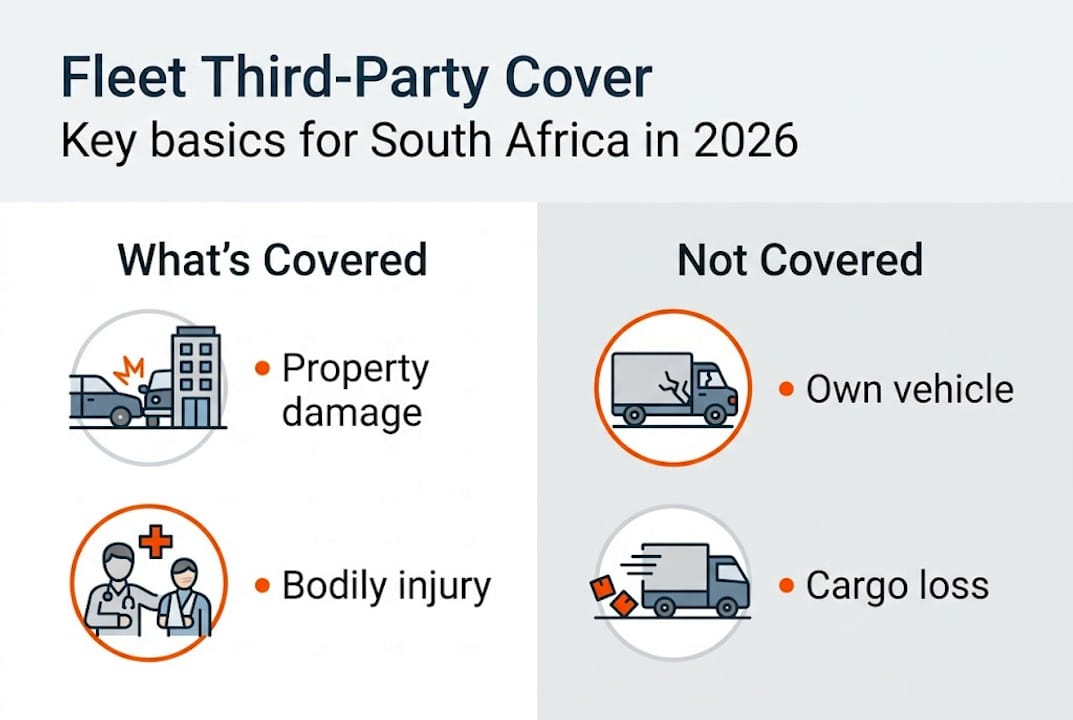
Here is a clear breakdown of what standard third-party cover includes versus what it excludes:
| Cover item | Included in third-party? |
|---|---|
| Third-party property damage | Yes |
| Third-party bodily injury or death | Yes |
| Legal defence costs (up to limit) | Yes |
| Damage to your own vehicle | No |
| Theft of your own vehicle | No |
| Cargo or goods in transit | No |
| Driver’s personal injury | No |
| Fire damage to your vehicle | No |
As the table shows, excluding own vehicle damage is a significant gap for operational fleets. If your tipper rolls and is written off, third-party cover pays nothing toward your own loss.
To address these gaps, fleet managers typically consider the following upgrade options:
- Third-Party, Fire and Theft (TPFT): Adds fire and theft cover for your own vehicle on top of the standard third-party base.
- Comprehensive cover: Covers your own vehicle damage, third-party claims, fire, and theft. Best for high-value or financed assets.
- Goods in Transit (GIT) cover: Protects cargo being transported, which third-party cover does not touch.
- Trailer scheduling: Adds specific trailers or attachments to your policy as separate insured items.
Pro Tip: If you operate a mixed fleet where some units are high-value and others are older standby vehicles, consider scheduling each asset individually. This lets you apply comprehensive cover where it matters most and keep costs lean on lower-risk units.
For a full view of your fleet liability options, including environmental liability cover for hazardous cargo operations, it pays to review your policy structure with a specialist broker annually.
Why limit size and scheduling matter for commercial fleets
Cover details differ depending on the size and scope of your fleet. Your policy’s structure and limits matter far more than most fleet managers realise.
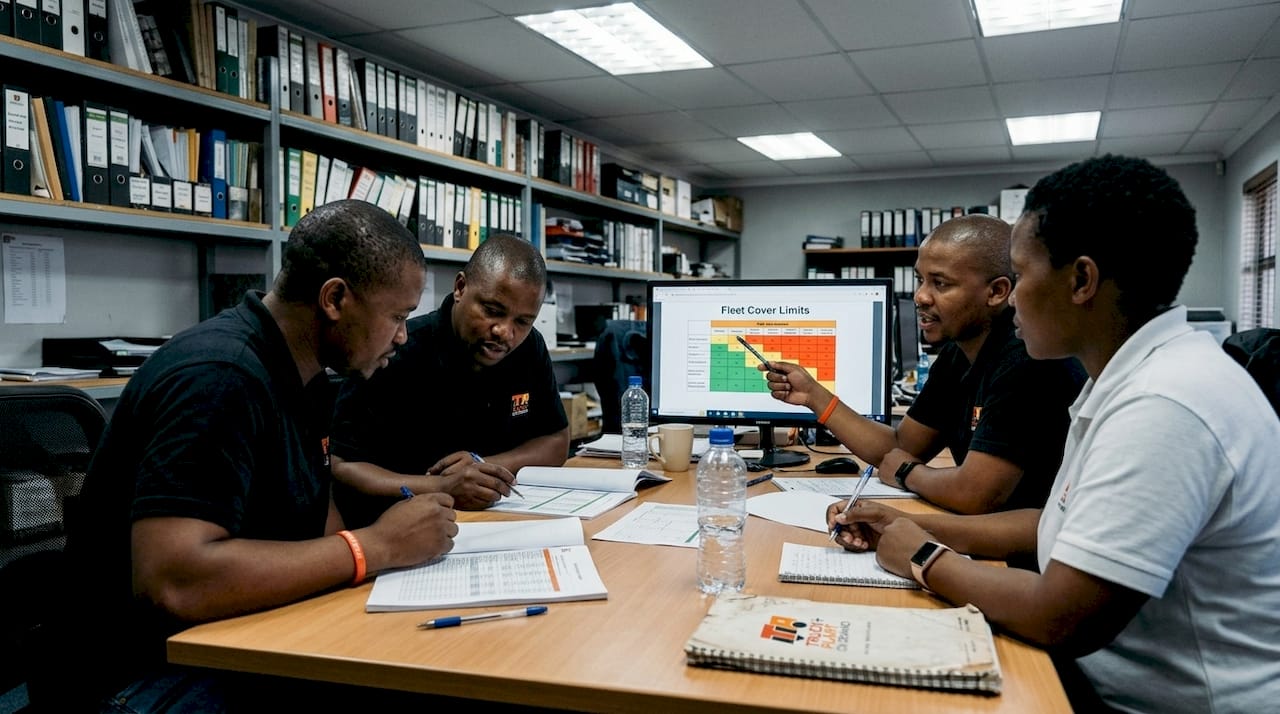
Heavy commercial vehicles over 3.5 tonnes GVM carry significant risk. A single incident involving an HCV can result in multi-vehicle damage, road closures, environmental contamination, and serious injury claims. High TPL limits are essential for HCVs precisely because the severity of potential losses is far greater than with light vehicles.
Here is a comparison of how limit size affects real outcomes:
| Scenario | Low TPL limit (R500k) | High TPL limit (R5m+) |
|---|---|---|
| Minor collision with a passenger car | Covered | Covered |
| Multi-vehicle highway incident | Potentially underinsured | Covered |
| Bridge or infrastructure damage | Significant shortfall | Covered |
| Third-party fatality with legal costs | Major exposure | Covered |
The gap between a low and high limit is not just financial. It can determine whether your business survives a major incident.
Key considerations for fleet scheduling and limit selection:
- Trailers and specialised attachments often need to be scheduled separately on your policy
- Plant machinery used on construction sites may require standalone cover outside your vehicle policy
- Fleet TPL recommendations suggest reviewing limits annually as asset values and operational risks change
- Cross-border operations require additional liability considerations beyond standard SA cover
With roughly 70% of commercial vehicles uninsured on SA roads, your risk exposure is compounded. Even with solid third-party cover, the chance of a collision involving an uninsured party is high. Higher limits and broader scheduling reduce the financial damage when that happens.
For insurance for construction fleets and specialist trailer cover, structuring your policy correctly from the start saves significant cost and stress later.
Filing a claim: Process, pitfalls, and how to improve your outcome
Knowing your policy inside out is one thing. Understanding how to act in an incident is just as crucial.
Here is the step-by-step process for filing a third-party claim after a commercial vehicle incident:
- Secure the scene: Ensure driver and third-party safety first. Move vehicles if safe to do so.
- Report to SAPS within 24 hours: Report accidents to police promptly, gather evidence, and contact your insurer without delay. Liability is determined by road rules and independent assessments.
- Gather evidence: Photographs, witness contact details, dashcam footage, and the other party’s ID and vehicle registration.
- Notify your insurer immediately: Delays in notification can affect your claim outcome.
- Submit documentation: Complete the claim form accurately and attach all supporting evidence.
- Follow up: Track your claim status and respond promptly to any insurer requests.
Pro Tip: Equip your drivers with a laminated incident card in every cab. It should list the exact steps to follow after an accident, including the insurer’s emergency number, what information to collect, and a reminder to never admit fault at the scene.
A real challenge in SA is the high rate of uninsured drivers. Claims may be ignored if the at-fault party is uncooperative, leaving you with limited options. In those cases, your recourse includes a formal letter of demand, Small Claims Court for lower amounts, or a civil suit for larger claims. Apportionment of negligence may also apply where both parties share fault.
The reality is that SA’s uninsured vehicle rate means third-party cover alone does not protect you from every financial risk on the road.
Understanding the factors impacting claim outcomes helps you prepare your fleet and your drivers for the unexpected.
When is third-party cover enough—and when should you upgrade?
The last piece of the puzzle: how do you decide if basic third-party is sufficient for your fleet’s operation?
Third-party cover is a practical fit in specific situations:
- The vehicle is low in value and not financed
- The unit is a standby or rarely used asset
- Budget constraints require the minimum legal cover while cash flow stabilises
- The vehicle is nearing end of life and replacement cost is low
However, third-party cover is risky for operational HCVs and active fleets. For financed assets or high-value machinery, it is better used as a base for add-ons rather than a standalone solution.
You should seriously consider upgrading when:
- Your vehicle is financed and the lender requires comprehensive cover
- The unit operates daily in high-risk environments like construction sites or long-haul routes
- You carry cargo or goods in transit that need separate protection
- Your fleet crosses borders and requires additional liability cover
- Theft or fire risk is elevated in your operating area
Pro Tip: Review your cover every quarter, not just at renewal. Business conditions change. A unit that was on standby six months ago may now be your highest-earning asset. Cover should reflect current operations, not last year’s assumptions.
For a clear view of your options, comparing cover types side by side helps you make informed decisions. If flexibility is a priority, on-demand cover options allow you to adjust your protection as your operational needs shift.
Expert take: Third-party cover is a foundation, not a full solution
Here is a direct perspective based on industry realities.
We see it regularly: fleet owners choose third-party cover to reduce costs, without doing a proper risk review. On paper, it looks like a sensible saving. In practice, it can be the most expensive decision a business makes when a serious incident occurs.
South Africa’s transport and construction environment is uniquely demanding. Roads are under pressure, infrastructure is ageing, and the rate of uninsured vehicles creates compounding exposure for every fleet on the road. Choosing the cheapest cover without accounting for these realities is not a cost-saving strategy. It is a risk transfer to your own business.
The smarter approach is layering. Third-party cover as your legal base, combined with Goods in Transit, SASRIA cover for civil unrest, and additional cover options for environmental liability, creates a protection structure that actually matches your exposure. Work with a fleet specialist broker. Benchmark your limits against industry norms. Stay agile and review quarterly. The goal is not the cheapest policy. It is the right policy for the risk your business actually carries.
Protect your fleet with the right cover
Third-party cover is where every SA fleet starts, but it does not have to be where you stop. At Truck & Plant On-Demand, we have built a flexible, on-demand insurance solution specifically for the civil, construction, and transport industries.
You choose what to insure, when to insure it, and how much cover you need. Whether you need truck insurance for a single unit or full fleet insurance cover for a large operation, we tailor protection to your actual business needs. Need trailer insurance scheduled separately? We handle that too. Stop paying for cover you do not need. Start paying only for the protection that matches your operations right now.
Frequently asked questions
Does third-party cover meet all legal requirements for my fleet in South Africa?
Yes, third-party cover is the minimum legal requirement for commercial vehicles on South African public roads. It satisfies your legal obligation to operate, but it does not protect your own assets.
Will third-party insurance pay for my own vehicle’s repairs in an accident?
No, third-party cover excludes damage to your own vehicle entirely. It only covers losses suffered by other parties as a result of your vehicle being at fault.
Why should I consider higher third-party liability limits for my fleet?
Higher limits cover severe losses common in transport and construction, such as multi-vehicle crashes or major property damage. Experts recommend high TPL limits because the potential severity of incidents involving HCVs far exceeds standard passenger vehicle scenarios.
What if an uninsured driver hits my vehicle—can I still claim?
If the at-fault party is uninsured and uncooperative, claims may be ignored and you may need to pursue recourse via Small Claims Court, a civil suit, or rely on your own comprehensive cover.
Is third-party cover enough for construction or heavy haulage fleets?
It meets the legal minimum, but operational fleets with high-value assets should treat third-party as a base and add broader cover to match their actual risk exposure.