


TL;DR:
- A tool hire business needs core policies such as inland marine, general liability, and commercial auto to address key risks. Specialty covers like cyber liability and equipment breakdown supplement the basic framework based on operations. On-demand insurance options help align coverage costs with fluctuating business activity and equipment usage.
A U.S. tool hire business needs five core policies: an Inland Marine/Contractors Equipment Floater, general liability, commercial auto, workers’ compensation, and an umbrella or excess liability policy. Beyond those, specialty covers including product liability, cyber liability, hired and non-owned auto, and short-term on-demand cover round out a complete programme depending on your operations.
Start here if you’re short on time: buy Inland Marine and general liability first. Those two policies address your biggest exposures, your equipment and your third-party liability, before you layer on anything else. The U.S. Small Business Administration also recommends a Business Owner’s Policy (BOP) as a cost-effective bundle for small operators, and Truck & Plant On-Demand™ offers a usage-based alternative for businesses whose cover needs shift week to week.
Core policies at a glance:
- Inland Marine / Contractors Equipment Floater — covers physical loss or damage to tools and equipment on-site, in transit, and off-premises
- General liability — covers third-party bodily injury, property damage, and advertising injury
- Commercial auto — covers owned, registered vehicles used in your business
- Workers’ compensation — required in most U.S. states; covers employee injury and lost wages
- Business Owner’s Policy (BOP) — bundles general liability, commercial property, and business interruption into one contract
- Umbrella / excess liability — extends limits above your underlying policies when a single claim exceeds them
Specialty covers to consider:
- Hired and non-owned auto (employee or rented vehicles)
- Product liability (injury from a defective tool)
- Cyber liability (customer data breaches, ransomware)
- Equipment breakdown (internal mechanical or electrical failure)
- Short-term or item-specific rental cover via on-demand products like Truck & Plant On-Demand™
Table of Contents
- What are the main tool hire business insurance types?
- What does equipment rental / inland marine cover actually include?
- Which policy stack fits your type of tool hire operation?
- How much does tool hire business insurance typically cost?
- How do you choose the right cover and what should you ask a broker?
- What exclusions and red flags should you watch for?
- How does the claims process work, and what speeds up payment?
- How can on-demand cover work for tool hire businesses?
- Key takeaways
- The real gap most tool hire owners miss
- Truck & Plant On-Demand™ gives tool hire businesses cover that moves with them
- Sources and further reading
What are the main tool hire business insurance types?
Every policy in your programme addresses a distinct risk category. Here is what each one does and who typically needs it.
- Inland Marine / Contractors Equipment Floater: Covers owned, rented, leased, or borrowed equipment against theft, vandalism, fire, flood, and collision. This is the cornerstone of any tool hire insurance programme because standard commercial property stops covering equipment the moment it leaves your premises.
- General liability: Pays for third-party bodily injury, property damage, and related legal costs. Every tool hire business needs it, regardless of size.
- Commercial property / BOP: Protects your building, fixtures, and on-premises inventory. A BOP bundles general liability, commercial property, and business interruption, making it the most cost-effective starting point for small and medium operators.
- Commercial auto: Covers trucks, vans, and trailers registered to your business. Commercial auto and hired and non-owned auto are separate exposures; owned vehicles need commercial auto, while employee-driven or rented vehicles need hired and non-owned auto.
- Workers’ compensation: Mandatory in nearly every U.S. state once you have employees. It covers medical expenses and lost wages for on-the-job injuries.
- Umbrella / excess liability: Sits above your general liability, commercial auto, and other underlying policies. When a single claim exhausts a primary limit, the umbrella responds.
- Short-term / item-specific rental cover: On-demand products let you activate cover for a single item or a short hire period, which is more cost-effective than carrying a blanket annual policy for low-frequency rentals.
Standard BOPs do not always cover industry-specific hazards. Cyber liability and product liability may be necessary to prevent catastrophic financial loss, so evaluate them alongside your foundational policies rather than treating them as optional extras.

What does equipment rental / inland marine cover actually include?
Inland Marine, also called a Contractors Equipment Floater, is the designated solution for equipment that moves. Standard commercial property policies exclude equipment once it leaves your insured premises, which means a claim for a stolen generator on a jobsite or a damaged compressor in transit will typically be denied under a property policy alone.
Key coverage features
- Off-premises and in-transit coverage: Protects equipment at customer sites, on delivery trucks, and at temporary storage locations.
- Care, custody, and control (CCC): Covers damage to equipment in your possession that belongs to a third party, such as a tool you are renting out that gets damaged while with a customer.
- Scheduled vs. blanket coverage: Scheduled coverage lists each item individually with its serial number and replacement value, producing lower per-item premiums for high-value plant. Blanket coverage applies a single limit across all tools, which suits high-turnover small-tool inventories where updating a schedule constantly would be impractical.
- Newly acquired provision: Most policies auto-cover new equipment for a limited window, commonly 30–90 days, giving you time to add it to your schedule before a gap in cover appears.
- Loss payee / finance company clauses: If equipment is financed or leased, the lender is named as a loss payee and receives claim proceeds up to their interest.
Replacement cost vs. actual cash value
Replacement cost (RC) pays what it costs to buy an equivalent new item today. Actual cash value (ACV) deducts depreciation, which can leave a significant shortfall on older equipment. For tools and heavy plant, RC cover is almost always worth the higher premium.
Covered causes and common exclusions
Covered causes typically include theft, vandalism, fire, flood, and collision during transit. Internal mechanical breakdown is usually excluded from Inland Marine and must be added as a separate endorsement.
| Coverage type | Primary focus | Common exclusions |
|---|---|---|
| Inland Marine / Equipment Floater | Off-premises, in-transit, and jobsite equipment | Mechanical breakdown, wear and tear, intentional damage |
| Commercial property | On-premises buildings and contents | Off-premises losses, transit, employee theft (unless endorsed) |
| Builders Risk | Structure under construction | Completed structures, equipment not incorporated into the build |
Which policy stack fits your type of tool hire operation?
Different business models carry different risk profiles. The right cover depends on where your equipment goes, who operates it, and how it is financed.
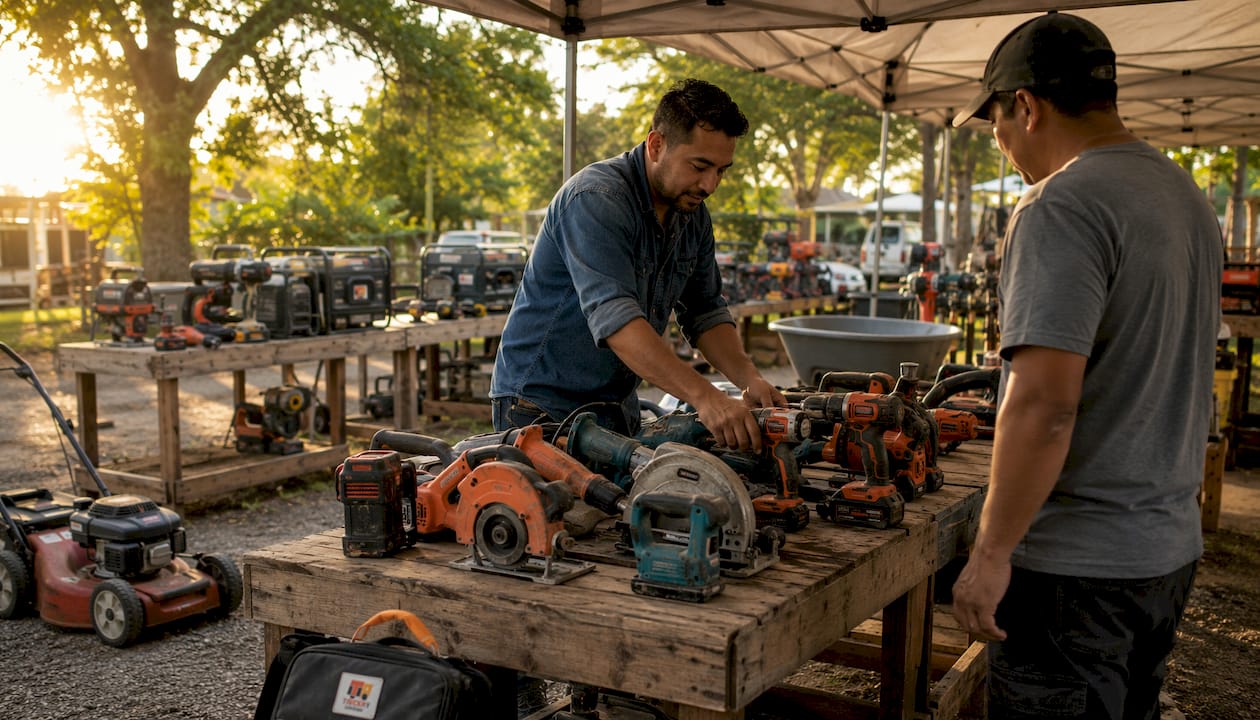
Shop-based rental (counter hire):
General liability, commercial property or BOP, and an Inland Marine floater for items that leave the shop. Workers’ comp if you have staff. This is the minimum viable stack for a fixed-location tool hire shop.
Mobile delivery and technician model:
Add commercial auto for your delivery vehicles and hired and non-owned auto if technicians use personal vehicles. Your Inland Marine policy needs to explicitly cover in-transit losses, not just jobsite losses.
Heavy plant hire:
Scheduled Inland Marine for each machine, with replacement cost values updated annually. Finance companies will require loss payee endorsements. Plant hire operations also face higher liability exposure, so umbrella limits of several million dollars are common.
Peer-to-peer or event rental platform:
Short-term, item-specific cover is often more practical than a blanket annual policy. Rental damage waivers offered by vendors typically cost 10–15% of rental fees; adding rented-equipment coverage to your own Inland Marine policy can work out cheaper for frequent hirers.
Seasonal and event-based operators: if your exposure spikes during summer construction season or around major events, on-demand cover lets you increase limits for the active period and scale back when inventory sits idle. Paying a flat annual premium for cover you only need six months of the year is a straightforward cost that on-demand products are designed to eliminate.
Contract-driven requirements matter too. Rental agreements often obligate the lessee to carry insurance and name you as an additional insured. Review your standard hire contract against your policy wording to confirm those obligations are met before a claim arises.
How much does tool hire business insurance typically cost?
Premium is driven by equipment value, claims history, location, security measures, and how your tools are used. Typical Inland Marine premium ranges are $150–$650 per year for hand tools and small equipment with $5,000–$25,000 limit; $400–$1,500 per year for mid-size equipment; and $800–$3,500+ per year for heavy equipment, though wide variation exists depending on value and exposure:
| Equipment class | Typical limit | Estimated annual premium |
|---|---|---|
| Hand tools and small equipment | $5,000–$25,000 | $150–$650 |
| Mid-size equipment (compressors, generators) | varies | $400–$1,500 |
| Heavy equipment (excavators, cranes) | varies | $800–$3,500+ |
These are indicative ranges. Your actual premium will depend on the factors below.
These are indicative ranges. Your actual premium will depend on the factors below.
Primary pricing drivers:
- Total insured value: The single biggest lever. Accurate replacement cost values keep you neither over-insured nor under-insured.
- Scheduling vs. blanket: Scheduling high-value items with serial numbers reduces per-item premium; blanket limits suit small-tool inventories where the administrative cost of scheduling outweighs the savings.
- Claims history: Three or more losses in five years will push premiums up and may restrict coverage terms.
- Security measures: Locked storage, GPS tracking, and chain-of-custody logs all reduce underwriter risk and can lower your rate.
- Location and jobsite exposures: Urban areas with higher theft rates or coastal zones with weather exposure attract higher premiums.
- Deductible selection: A higher deductible lowers your premium but increases your out-of-pocket cost per claim. Match the deductible to what you can absorb without disrupting cash flow.
Pro Tip: Bundle general liability and commercial property into a BOP before buying stand-alone policies. The SBA notes that bundling reduces both cost and administrative complexity, and most carriers allow you to add an Inland Marine floater as an endorsement to a BOP.
How do you choose the right cover and what should you ask a broker?
Arriving at a broker meeting with the right documents cuts quoting time and reduces the risk of coverage gaps.
Pre-quote documentation checklist
- Complete equipment inventory with serial numbers, purchase dates, and current replacement values
- Recent photos of all high-value items
- Copies of your standard rental agreement and any lessee insurance requirements
- Five-year claims history from your current or previous insurer
- Finance or lease documents for any equipment with a lender interest
- Details of security measures: storage facilities, GPS devices, alarm systems
Questions to ask your agent or broker
- Does the policy cover equipment at any U.S. location, or are there territorial sublimits?
- What is the off-premises limit, and does it match my highest-value single item?
- How does the policy handle the overlap between commercial auto and Inland Marine for equipment in transit on my own trucks?
- What sublimit applies to care, custody, and control losses?
- How long is the newly acquired equipment window, and what is the notification process?
- Can I add equipment breakdown as an endorsement, or does it require a separate policy?
BOP vs. stand-alone inland marine
A BOP works well when your primary exposure is on-premises and your equipment inventory is modest. Once you have high-value plant leaving the shop regularly, a stand-alone Inland Marine or Contractors Equipment Floater gives you more precise control over limits, scheduling, and endorsements. Many operators carry both: a BOP for the shop and a floater for the fleet.
Pro Tip: Ask for a “blanket with scheduled items” structure. You get blanket coverage for small tools and scheduled coverage for your top five to ten high-value items, balancing administrative effort against premium savings.
What exclusions and red flags should you watch for?
Knowing what a policy does not cover is as important as knowing what it does.
Common exclusions:
- Wear and tear or gradual deterioration
- Internal mechanical or electrical breakdown (unless specifically endorsed)
- Intentional damage or mysterious disappearance without evidence of forced entry
- Employee theft (requires a separate crime or fidelity bond endorsement)
- Off-site sublimits that are far lower than your total equipment value
Red flags in policy wording:
- Per-item sublimits buried inside a blanket policy that cap your recovery on any single item well below replacement cost
- Broad care, custody, and control exclusions that effectively eliminate coverage for equipment in a customer’s hands
- Newly acquired clauses with a 30-day window and no automatic extension, which can leave recently purchased equipment uninsured
Practical risk-management steps that also reduce premium:
- Secure all equipment in locked, alarmed storage when not on hire
- Fit GPS tracking units to high-value mobile plant; carriers often offer a discount for documented tracking
- Maintain chain-of-custody logs for every hire transaction
- Require customers to sign a use agreement that specifies permitted use, care obligations, and liability for damage
- Keep preventive maintenance logs; they demonstrate due diligence and support claims for equipment that fails in the field
For a structured approach to how construction fuel logistics are managed on job sites, Truckplant’s risk management guidance covers the operational controls that underwriters look for most.
Pro Tip: Review your policy’s definition of “theft.” Some policies require visible signs of forced entry. If a tool disappears from an unlocked van, that claim may be denied. Confirm the exact theft definition before you bind cover.
How does the claims process work, and what speeds up payment?
A well-documented claim settles faster and with less dispute. Here is the typical workflow.
- Immediate mitigation: Secure the remaining equipment, prevent further loss, and photograph the scene before anything is moved.
- Notify your carrier: Report the loss as soon as practicable. Late notification is one of the most common grounds for a coverage dispute.
- Preserve evidence: Keep damaged items until the adjuster inspects them. For transit losses, retain GPS or telematics data showing the route and any incidents.
- Submit proof of loss: Provide a completed proof-of-loss form within the timeframe your policy specifies, typically 60–90 days.
- Adjuster inspection: The carrier assigns an adjuster who will inspect the damage, review your documentation, and assess the claim value.
- Settlement or repair approval: The carrier either approves a repair, issues a replacement cost payment, or pays ACV if that is what your policy provides.
Documentation checklist for a faster settlement:
- Signed rental agreement showing the equipment was on hire at the time of loss
- Serial numbers and scheduled values from your policy
- Before and after photographs
- GPS or telematics data for any transit incident
- Police report for theft or vandalism
- At least two independent repair or replacement cost estimates
- Maintenance logs showing the equipment was in good working order before the loss
When equipment is damaged while with a customer, communicate clearly about the claims process and issue a certificate of insurance to the customer if your rental agreement requires it. Transparency at this stage prevents disputes that slow settlement.
Statistic callout: Equipment breakdown, internal mechanical or electrical failure, is typically excluded from Inland Marine policies and must be purchased as a separate endorsement. Operators who discover this exclusion after a loss face repair costs entirely out of pocket.
How can on-demand cover work for tool hire businesses?
On-demand, usage-based insurance is well suited to tool hire operations where exposure is not constant. Truck & Plant On-Demand™ is built on the premise that you should not pay the same premium every month when the cover you need changes with your workload.
Use cases where on-demand cover reduces cost:
- Short-term rentals where a single item is on hire for one to five days
- Seasonal spikes when your fleet doubles in summer and sits idle in winter
- One-off deliveries of high-value plant to a new customer or site
- Demo equipment loans where the item is temporarily off your premises
Benefits of a usage-based approach:
- Pay-for-use premiums that reflect actual exposure rather than a flat annual rate
- Flexible limits that you can adjust as your inventory changes
- Digital certificates of insurance generated on demand for each hire transaction
- Integration with rental management software for automated cover activation
- Faster digital claims handling aligned with your rental records
What to check before activating on-demand cover:
- Minimum activation period: some products require a minimum of one day; others activate by the hour.
- How replacement cost is handled: confirm the policy pays RC, not ACV, for high-value items.
- Territory limits: confirm cover applies at all U.S. locations where your equipment operates.
- Mobile app or API integration: check whether the product connects with your existing rental software to avoid manual activation errors.
- Claims workflow: confirm the digital evidence requirements align with the documentation you already collect.
For more on how on-demand insurance fits construction and transport operations, Truckplant’s published guidance covers the practical integration steps in detail.
Pro Tip: When evaluating on-demand products, ask specifically how limits are applied: per-day, per-activation, or per-item. A per-activation model with a high minimum premium can cost more than a blanket annual policy for a busy hire shop. Run the numbers against your actual hire frequency before switching.
Key takeaways
A tool hire business’s most critical first purchases are Inland Marine cover and general liability. Every other policy builds on that foundation.
| Point | Details |
|---|---|
| Start with Inland Marine and general liability | These two policies cover your biggest exposures: equipment loss and third-party liability claims. |
| Use a BOP for cost efficiency | Bundling general liability, commercial property, and business interruption into a BOP reduces cost and administrative complexity for small operators. |
| Schedule high-value items | Listing expensive plant with serial numbers lowers per-item premium; use blanket cover for high-turnover small tools. |
| Know your exclusions | Mechanical breakdown, employee theft, and off-site sublimits are the most common coverage gaps that catch operators unpaid. |
| Truckplant’s on-demand option | Truck & Plant On-Demand™ lets you pay for cover only when equipment is active, reducing cost during low-hire periods. |
The real gap most tool hire owners miss
Most tool hire operators I speak with have general liability sorted. What they consistently underestimate is how narrow their equipment cover actually is. A commercial property policy feels like it covers everything in the business. It does not. The moment a tool leaves your premises, that policy typically stops responding, and the claim gets denied.
The second gap is mechanical breakdown. Operators assume that if a piece of plant fails on a customer’s site, their Inland Marine policy pays. It does not, unless they have specifically endorsed it. That exclusion is buried in the policy wording, and most owners only find it when they need it most.
On-demand cover addresses a different problem: the mismatch between a flat annual premium and a business where exposure genuinely fluctuates. Paying for twelve months of cover on equipment that is only on hire for six is a straightforward inefficiency. The tool hire businesses that manage insurance costs well are the ones that match their cover structure to their actual operational rhythm, not the ones that simply buy the cheapest annual policy and hope for the best.
Truck & Plant On-Demand™ gives tool hire businesses cover that moves with them
Tool hire operations do not run on a fixed schedule, and your insurance should not either. Truck & Plant On-Demand™ is built specifically for businesses in the civil, construction, and transport industries where equipment exposure changes daily. You choose what to insure, when to insure it, and how, without paying a flat monthly premium for cover you are not using.
For tool hire businesses, that means activating cover for a single high-value item on a short hire, scaling up during peak season, and scaling back when inventory is idle. Digital certificates, real-time adjustable limits, and claims workflows that align with your rental records make the process straightforward. Whether you run a counter hire shop, a mobile delivery fleet, or a heavy plant operation, Truckplant tailors cover to your actual exposure.
Get a quote for on-demand fleet cover or visit Truckplant.com to see the full range of tool hire and plant insurance options available to your business.
This article provides general information about business insurance types and is not professional insurance or legal advice. Confirm current coverage requirements and policy terms with a licensed insurance professional for your specific situation.
Sources and further reading
Regulatory and authoritative sources:
- Small Business Insurance Basics | Insurance Information Institute (III)
- Get business insurance | U.S. Small Business Administration
- Types of Business Insurance: Overview and Coverage | Bank of America
- Small business insurance: 12 types + how to choose | QuickBooks
- Construction Equipment Insurance: Cost and Coverage Guide
Truckplant resources for tool hire and plant operators:
- Tool of Trade Insurance | Truckplant
- Plant Hire Insurance | Truckplant
- On-demand insurance for construction and transport | Truckplant
- Rental machinery insurance cover | Truckplant
- Risk assessment process for construction | Truckplant