


For fleet and construction operators, the most practical starting point is all-risks open annual cover for continuous operations, or on-demand all-risks for intermittent plant moves and variable schedules. The six core types of goods-in-transit (GIT) insurance are: own goods (first-party), carrier liability (third-party), single-trip, open annual/blanket, stock-throughput, and on-demand/short-term. GIT insurance covers the cargo itself during land-based transport and is entirely separate from vehicle insurance, which protects the truck, not the load. Industry authorities including Hylant and Munich Re consistently flag the gap between vehicle cover and cargo cover as the most common source of uninsured losses. Truck & Plant On-Demand™ addresses that gap directly for operators with variable or intermittent transit needs.
The core rule: your fleet policy covers the truck. Your GIT policy covers what is inside it. Assuming one replaces the other is the single most expensive mistake a fleet or construction operator can make.
At a glance, the six types are:
- Own goods (first-party): covers your own stock or equipment in transit
- Carrier liability (third-party): covers customers’ goods you are hauling
- Single-trip/transit: per-move cover for one specific consignment
- Open annual/blanket: continuous cover for all moves within a policy year
- Stock-throughput: end-to-end cover from warehouse through transit to delivery
- On-demand/short-term: activated per move or per period, pay only when needed
Table of Contents
- What are the main types of goods-in-transit cover?
- How does the perils basis change what your GIT policy actually pays?
- Hazardous goods and high-value plant: what you must declare
- How do limits, valuation, and deductibles affect your claim payout?
- How do you choose the right GIT cover for your operation?
- How do you buy GIT quickly and what do you do if you need to claim?
- How Truck & Plant On-Demand™ closes the gaps standard GIT leaves open
- Key takeaways
- The gap most operators don’t see until it’s too late
- Truck & Plant On-Demand™: pay for cover when you actually need it
- Useful sources and further reading
What are the main types of goods-in-transit cover?
Common GIT policy forms span six distinct structures, each built for a different operating model. The table below maps each type to its practical use case.
| Cover type | What it covers | Best for |
|---|---|---|
| Own goods (first-party) | Your own stock, tools, or plant in transit | Owner-drivers, construction firms moving their own equipment |
| Carrier liability (third-party) | Customers’ goods you carry for hire or reward | Dedicated hauliers, contract carriers |
| Single-trip/transit | One named consignment, one move | High-value or one-off loads |
| Open annual/blanket | All qualifying moves across a policy year | High-frequency fleets, distribution operations |
| Stock-throughput | Goods from origin warehouse through transit to final delivery | Multi-location supply chains, 3PL users |
| On-demand/short-term | Cover activated per move or per period | Seasonal plant hire, intermittent moves, variable schedules |
Carrier liability protects you as the carrier for a customer’s goods, but it does not replace first-party own-goods cover when you are moving your own stock or equipment. Stock-throughput insurance fills the gaps that appear when goods move between owned warehouses, third-party logistics providers, and transport vehicles, reducing disputes about which policy responds. For most construction firms moving plant between sites, own-goods cover on an on-demand basis is the cleanest fit. Open annual policies suit fleets running predictable, high-volume routes where administration overhead is manageable.

How does the perils basis change what your GIT policy actually pays?
All-risks wording broadly covers accidental loss or damage unless specifically excluded; named-perils wording only pays for the risks listed in the policy. Named-perils cover is cheaper, but common claims such as loading damage or minor theft are often not on the list.
For high-value or diverse cargo, all-risks is the recommended basis. The premium is higher, but claim disputes drop significantly because there is no argument about whether a cause of loss was “listed.”
Common extensions worth adding to a base GIT policy:
- Theft and pilferage: covers partial theft, not just total vehicle hijack
- Loading and unloading damage: extends cover to the highest-risk moments of any move
- Temporary warehouse/storage in transit: protects goods held overnight or at a staging point
- Environmental cleanup: covers spill-related remediation costs, critical for fuel or chemical loads
- Refrigerated/temperature-sensitive cover: required for perishables or temperature-controlled materials
Common exclusions that catch operators off guard:
- Improper or inadequate loading (the insurer will investigate packing and securing methods)
- Undeclared hazardous materials (can void the entire claim)
- Wear, tear, and inherent vice
- Delay in transit (loss of market or consequential losses are almost never covered)
Pro Tip: If your fleet carries anything other than standard palletised goods, negotiate all-risks wording from the start. Retrofitting extensions after a claim is not possible, and named-perils gaps are rarely obvious until you need to make a claim.
Hazardous goods and high-value plant: what you must declare
The single non-negotiable rule: declare the correct hazard class and buy the matching endorsement before the load moves. Failing to declare voids standard GIT cover.
The DOT/FAA framework recognises nine hazard classes. For construction and fleet operations, the most relevant are:
- Class 3 (flammable liquids): diesel, paints, thinners, solvents
- Class 8 (corrosives): battery acid, certain cleaning agents
- Class 9 (miscellaneous): lithium batteries, battery-powered equipment, dry ice, asbestos
- Class 2 (gases): compressed gas cylinders on site vehicles
- Class 5 (oxidising substances): certain fertilisers and chemicals
For a practical hazmat compliance checklist covering packaging and labelling requirements, the ORNER guide is a useful operator reference.
High-value plant and machinery requires a separate conversation with your underwriter. Standard GIT limits are set per consignment and per vehicle, and a single excavator or crane component can exceed those limits easily. Agree a specific transit value for each major asset and confirm whether the policy settles on agreed value (fixed payout) or invoice/market value (subject to depreciation). Agreed value is almost always preferable for plant.
How do limits, valuation, and deductibles affect your claim payout?
Three valuation methods govern most GIT settlements:
- Invoice value: the commercial invoice amount, sometimes plus a percentage for freight and insurance costs
- Declared value: the value you state at inception or per declaration, which sets the maximum payout
- Agreed value: a fixed sum agreed with the insurer at policy start, not subject to depreciation argument
Typical limit structures run per vehicle, per consignment, and as an annual aggregate. Excesses (deductibles) apply per event, not per item within a load.
A simple example: if you declare a consignment at $80,000, carry a $2,500 deductible, and suffer a total loss, the insurer pays $77,500. If the same load was only declared at $60,000 because you underestimated value, you recover $57,500 regardless of actual loss. Underinsurance is the most common reason GIT claims pay less than operators expect.
| Valuation method | How it works | Risk to operator |
|---|---|---|
| Invoice value | Payout based on purchase invoice | Depreciation may reduce recovery |
| Declared value | Payout capped at stated declaration | Underinsurance if declaration is low |
| Agreed value | Fixed sum, no depreciation argument | Requires accurate asset valuation upfront |
For a plain-language breakdown of terms like “declared value” and “all-risks,” the insurance terminology guide for fleet owners is a practical reference.
How do you choose the right GIT cover for your operation?
Choose on-demand or single-trip all-risks for variable, high-value, or intermittent plant moves. Choose open annual or stock-throughput for continuous, multi-location inventory exposure. The decision framework below narrows it down.
- How often do you move goods? Daily high-volume routes suit annual blanket cover. Occasional or seasonal moves suit on-demand or single-trip.
- Who owns the goods? Your own stock needs first-party own-goods cover. Customer goods need carrier liability.
- Do you use subcontractors or 3PLs? If yes, stock-throughput eliminates the custody-gap disputes that standard business property policies leave open.
- Are any loads hazardous? Declare class and buy the endorsement before the move.
- What is your average consignment value? High-value loads warrant agreed-value wording and higher per-consignment limits.
- Do you cross state lines or borders? Confirm territorial limits and whether the policy extends to multimodal moves. For operators using port logistics, multimodal best practices affect how custody points are documented.
Questions to take to your broker: Does loading and unloading fall within the policy period? How are subcontractor moves declared? Are split limits applied per axle or per vehicle? What is the declaration cadence for open annual policies?
For tailored guidance on matching cover to fleet operations, Truckplant’s fleet insurance resource covers common coverage gaps in detail.
How do you buy GIT quickly and what do you do if you need to claim?
For fast cover, on-demand and single-trip options are the most practical. Have your consignment manifest, declared value, and hazard class information ready before you start the application.
Buying cover quickly:
- Confirm the load details: commodity, declared value, origin, destination, and hazard class if applicable.
- Select cover basis (all-risks recommended for plant or high-value loads).
- Declare any storage-in-transit requirements if the load will be held overnight.
- Activate cover digitally and retain the policy confirmation with the manifest.
If a loss occurs:
- Secure the scene and prevent further damage or loss.
- Photograph the load, vehicle, and any damage before moving anything.
- Retain the manifest, bill of lading, and delivery documentation.
- Obtain a police report if theft or third-party damage is involved.
- Notify your insurer within the timeframe stated in the policy (late notice is a common grounds for denial).
- Preserve any salvage. Do not dispose of damaged goods without insurer authorisation.
Pro Tip: Notify your insurer immediately, even if the full extent of loss is not yet known. A preliminary notification protects your claim date. Waiting until you have all the details often pushes you past the policy’s notification window.
For a full breakdown of documentation and claims handling, the role of insurance in transport operations guide covers manifests and proof-of-value requirements.
How Truck & Plant On-Demand™ closes the gaps standard GIT leaves open
On-demand GIT removes wasted premium and closes the coverage gap between vehicle insurance and cargo cover by letting you buy specific-transit all-risks protection exactly when you need it. Standard annual policies charge a fixed premium regardless of whether your fleet is active, which means you pay for cover on days nothing moves.
Consider a construction firm moving two excavators between project sites three times a month. An annual blanket policy charges for 365 days of cover. An on-demand policy charges for the six to eight transit days that actually carry risk. The saving is real, and the coverage is identical in scope.
Coverage gap reality: standard business property policies commonly exclude goods while in transit or at third-party storage sites. Vehicle insurance covers the truck. On-demand GIT covers the load, activated the moment it moves.
Truck & Plant On-Demand™ handles digital declarations, real-time cover activation, and integrates with your existing manifests. When a claim arises, there is no dispute about which policy responds because the cover was activated specifically for that move. Hylant and Munich Re both note that coverage disputes are most common at custody transitions, precisely the point where on-demand, move-specific cover eliminates ambiguity. You can review Truckplant’s goods-in-transit cover options to see how the product is structured.
Key takeaways
Choosing the right GIT cover type is the single most important decision fleet and construction operators make, because vehicle insurance never covers the load.
| Point | Details |
|---|---|
| GIT vs vehicle insurance | Your fleet policy covers the truck; a separate GIT policy must cover the cargo. |
| All-risks for high-value loads | Named-perils cover frequently excludes loading damage and minor theft — all-risks reduces claim disputes. |
| Declare hazardous goods | Failing to declare the correct DOT/FAA hazard class can void your entire GIT claim. |
| On-demand for variable moves | Per-move cover eliminates wasted premium on days your fleet is not active. |
| Truck & Plant On-Demand™ | Truckplant’s on-demand GIT activates digitally per move, matching cover precisely to your transit schedule. |
The gap most operators don’t see until it’s too late
The most persistent mistake in fleet and construction insurance is assuming that a comprehensive vehicle policy is “close enough” to cargo cover. It is not. The truck is insured. The excavator on the back is not.
What surprises me most, having worked with fleet and plant operators across the industry, is how rarely this gap is discovered proactively. It surfaces at the worst possible moment: after a loss, when the vehicle insurer correctly declines the cargo claim and the operator realises they had no GIT policy in place. The fix is straightforward. On-demand cover exists precisely for operators whose transit schedule is irregular. You do not need to pay for 365 days of cargo cover if your plant moves six times a month. The industry has caught up with how construction and fleet operations actually work. The question is whether your insurance structure has.
Truck & Plant On-Demand™: pay for cover when you actually need it
Truckplant built Truck & Plant On-Demand™ specifically for fleet operators and construction companies who need GIT cover that matches how they actually work, not how an annual policy assumes they work. You activate cover per move, adjust limits in real time, and pay only for the transit days that carry real risk.
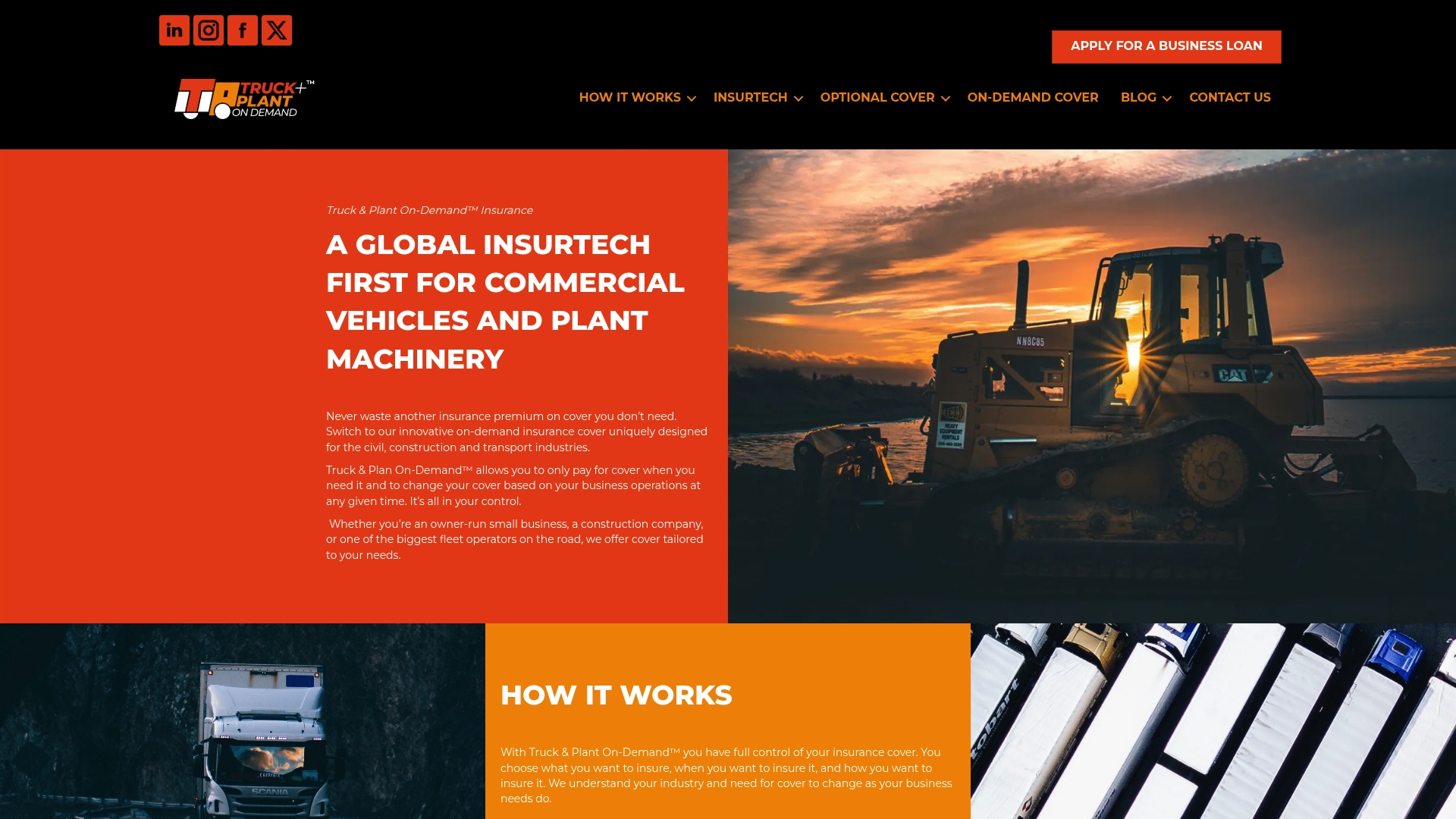
The product covers commercial vehicles, plant machinery, and tools in transit, with digital declarations that integrate directly with your manifests. Claims support is built in, so when a loss occurs, the documentation trail is already in place. No annual premium for idle days. No coverage gaps between your vehicle policy and your cargo.
Get a quote for on-demand fleet cover and see how much you can save by paying only for the cover you use.
Useful sources and further reading
- Federal Aviation Administration: What are Dangerous Goods? — primary reference for DOT/FAA hazard class declarations; consult before moving any hazardous load.
- Hylant: What Is Stock Throughput Insurance? — authoritative guide to stock-throughput policy structure, custody gaps, and documentation requirements.
- Munich Re: Stock Throughput Insurance — high-authority reference on why standard property and vehicle policies exclude in-transit goods.
- Insure24: Goods in Transit Insurance Explained — practical breakdown of GIT policy types and the cargo-vs-vehicle distinction.
- MBFS: Goods in Transit Insurance Guide — covers all-risks vs named-perils trade-offs and open annual policy structures.
- Holmes Murphy: Why Stock Throughput Matters — US-focused analysis of domestic cargo, ocean cargo, and STP integration for supply chain operators.