


Hourly insurance, known in the industry as on-demand or usage-based cover, is commercial insurance you activate only while a truck, trailer, or piece of plant is actively working. You pay for the hours the asset is in use and nothing more. For South African fleet operators, plant hire firms, and construction businesses with assets that sit idle between projects, this model directly cuts the premium waste built into traditional annual policies. Truck & Plant On-Demand™ is a market-ready example. Applications are processed within an hour when documentation is complete, and claims are authorised within 48 hours when documents are in order. The FSCA-authorised framework, telematics integration with providers such as Cartrack, and machine-level activation make it a practical fit for civil, construction, and transport operations across South Africa.
Key takeaways
On-demand hourly insurance cuts premium waste for South African fleets by charging only for active cover periods, verified through telematics.
| Point | Details |
|---|---|
| Definition | Hourly cover activates per asset while it works; you pay nothing during idle periods. |
| Best use case | Plant hire, seasonal contractors, and fleets with meaningful idle time between projects benefit most. |
| Top pricing drivers | Asset value, cover type, location, driver profile, and telematics quality all affect the hourly rate. |
| Telematics is central | Continuous telematics data verifies usage, supports faster claims, and builds a risk profile that can reduce rates over time. |
| Truckplant next step | Request a pilot via Truck & Plant On-Demand™: onboarding within an hour, claims authorised within 48 hours when documents are complete. |
Table of Contents
- How hourly cover works for trucks, trailers, and plant
- Who benefits most from on-demand cover?
- Benefits, trade-offs, and limitations you should know
- What determines the hourly rate?
- What to check in an on-demand policy
- How to implement hourly cover across your fleet
- Telematics: the engine behind fairer hourly pricing
- South Africa-specific checks: regulator, employer obligations, and contracts
- Telematics and hourly cover in action: a plant hire scenario
- A fleet manager’s perspective on hourly cover
- Truck & Plant On-Demand™: try hourly cover for your fleet
- Sources
How hourly cover works for trucks, trailers, and plant
The operational flow is straightforward. You activate cover through a mobile app, API, or fleet management integration when the asset starts work. Telematics records ignition state, engine hours, GPS position, and PTO activity throughout the shift. When the asset stops, you deactivate, and billing is calculated against the active period, subject to any minimum activation block in your policy. If a claim arises, you submit the relevant documentation and the insurer reviews it against the recorded usage data.
Activation triggers vary by setup:
- Manual app toggle: the operator switches cover on and off via a smartphone app before and after each shift.
- Ignition or geofence trigger: the telematics device detects ignition-on or entry into a work zone and activates cover automatically.
- API integration: rental or fleet software pushes activation signals directly to the insurer when a hire agreement opens or closes.
Real-time policy updates mean your cover reflects actual operations rather than a fixed schedule agreed months in advance. Most policies use either true-hourly billing or minimum activation blocks (for example, a four-hour minimum per activation). Understanding which model applies to your fleet matters before you commit.
Who benefits most from on-demand cover?
On-demand cover lowers total cost compared with fixed annual premiums for assets that are not working continuously. The clearest beneficiaries are:
- Owner-drivers with intermittent loads: a truck that runs three days a week does not need seven days of cover.
- Plant hire firms: excavators, cranes, and compactors sit between hire agreements. Activating cover machine-by-machine means you pay only for booked periods.
- Seasonal contractors: road construction crews that work intensively for six months and then stand down carry unnecessary premium for the other six on annual policies.
- Fleets with idle assets between projects: a civil engineering firm with ten trucks but only six deployed at any time can keep the idle four on reduced or paused cover.
- Specialised heavy lift and crane hire: high-value assets with short, defined operating windows are well suited to on-demand activation.
Assets that run continuously at high exposure, such as long-haul trucks on daily routes, typically still suit annual cover. The savings calculation only favours hourly cover when idle time is meaningful.
Benefits, trade-offs, and limitations you should know
| Benefit | Limitation |
|---|---|
| Pay only for active cover periods | Coverage gap if activation is missed or delayed |
| Cashflow aligns with project billing | Minimum activation blocks can reduce savings on short jobs |
| Idle assets carry no premium | Per-hour rates may be higher than the annual equivalent rate |
| Cover adjusts as fleet composition changes | Admin overhead increases if activation is manual across many assets |
| Telematics data supports faster claims | Territorial limits (some policies cap operating radius) apply |
The territorial point matters in South Africa. Some on-demand policies include radius restrictions, so confirm whether your routes or project sites fall within the covered area before activating.
Pro Tip: Sharing telematics data consistently with your insurer creates a feedback loop. Combining on-demand cover with telematics lets insurers price from measured usage rather than broad assumptions, which tends to reduce your rate over time as your risk profile becomes clearer.
What determines the hourly rate?
Several factors drive the price per active hour. Understanding them helps you manage costs rather than simply accept a quoted rate.
- Asset retail value and age: higher replacement cost means higher premium per hour.
- Cover type: comprehensive cover costs more per hour than fire-and-theft or third-party-only.
- Operating location and radius: urban high-theft areas and extended radius operations attract higher rates.
- Driver and crew profile: licence history, experience, and training records all influence risk assessment.
- Telematics quality: verified, continuous data from a calibrated device supports better pricing than self-reported hours.
- Security measures: tracking devices, immobilisers, and secure overnight parking reduce the rate.
- Claims history: a clean record lowers your risk classification over time.
- Activation granularity and minimums: shorter minimum blocks give you more control but may carry a slightly higher per-unit rate.
As a rough illustration (example only, not a quoted rate): an owner-driver truck used approximately a moderate amount of hours per month might attract an hourly rate varying depending on cover type and location. A plant hire excavator activated for a 120-hour project might sit in a different band given its asset value and cover scope. Vehicle insurance costs are rising in South Africa as inflation pushes parts and repair costs higher, which feeds into base rates generally. Telematics-verified risk profiles are one of the few levers that can offset that upward pressure. For a detailed comparison of annual versus on-demand costs, the annual vs on-demand comparison guide is worth reviewing before your next renewal.
What to check in an on-demand policy
Use this checklist when evaluating any hourly cover product:
- Covered perils: confirm whether comprehensive, fire-and-theft, and third-party liability are all available or only selected options.
- Covered assets: verify that your specific asset classes (rigid trucks, trailers, cranes, excavators, small plant, tools) are listed.
- Territorial limits: confirm the operating radius and any cross-border exclusions.
- Minimum activation unit: know whether you are billed per hour, per four hours, or per day.
- Maximum continuous duration: some policies require re-activation after a set period.
- Telematics requirements: confirm which devices are supported and whether the insurer requires a specific integration.
- Authorised repairers: check whether you must use a panel repairer or can choose your own.
- Claims turnaround SLA: 48-hour authorisation when documents are complete is a reasonable benchmark.
- Required claim documents: typically include the policy schedule, driver declaration, incident report, and photos.
- Theft reporting window: plant all-risk policies typically require theft to be reported to the police within 24 hours of discovery.
Ask the insurer directly: how is activation verified if the telematics signal drops? What happens if hours are disputed? Is there a daily or weekly cap on active hours? These questions surface gaps before a claim, not during one.
How to implement hourly cover across your fleet
A phased rollout reduces risk and gives you real cost data before committing the full fleet.
- Assess asset usage profiles. Pull engine-hour or mileage records for each asset. Identify which units have meaningful idle time between jobs. Those are your pilot candidates.
- Agree telematics and data flows. Confirm which telematics devices are installed, whether they meet the insurer’s requirements, and how activation signals will be transmitted (app, API, or manual).
- Run a pilot on one to three assets for four to eight weeks. Choose assets with clear active/idle windows so the savings signal is easy to read.
- Review results. Compare actual premium spend against what the annual equivalent would have cost for the same period. Note any activation gaps, admin friction, or claims events.
- Scale and integrate. Once the pilot validates savings and process, extend to the broader fleet and connect activation to your rental or fleet management software.
Pro Tip: Choose pilot assets that have the sharpest contrast between working hours and idle time, such as a crane hired for specific lifts or a compactor used only during active earthworks. The clearer the on/off pattern, the easier it is to measure savings and catch any activation gaps early.
Tailored fleet insurance strategies can help you structure the rollout to match your operational calendar.
Telematics: the engine behind fairer hourly pricing
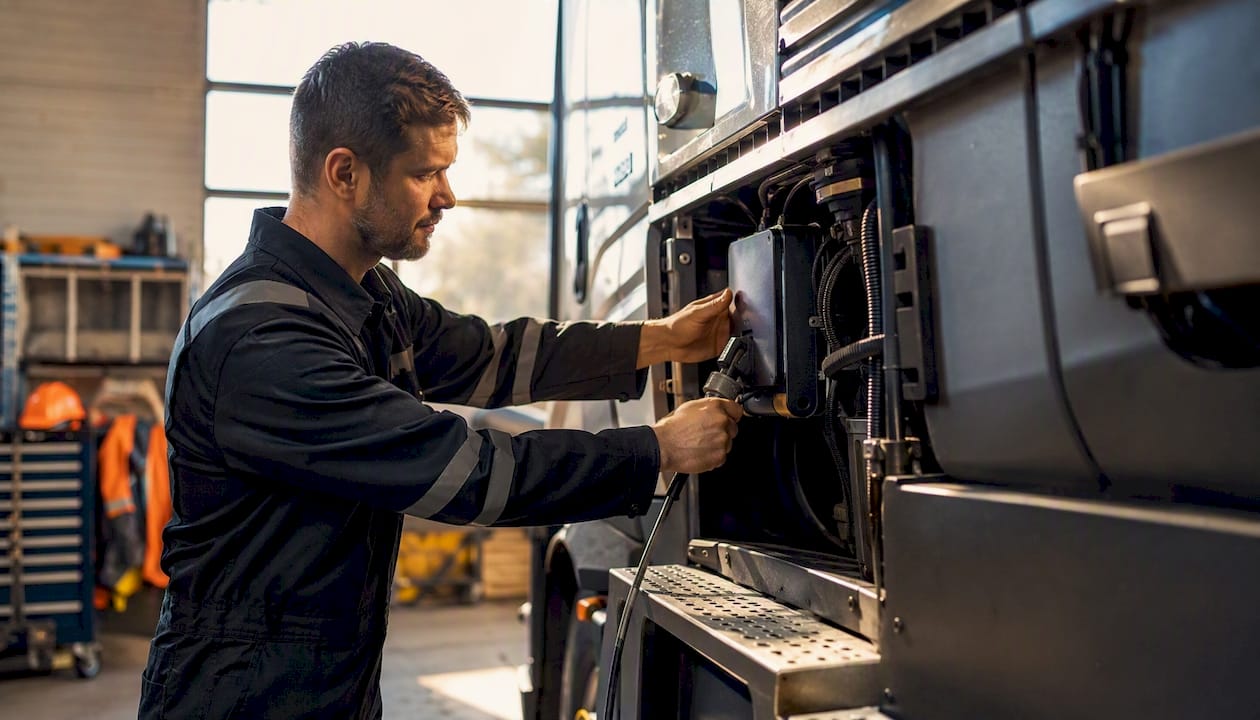
Telematics is what makes usage-based pricing credible rather than approximate. The data types that matter most for on-demand commercial cover include:
- Ignition on/off and engine hours
- PTO (power take-off) activity for cranes, tippers, and concrete mixers
- GPS location and geofencing
- Speed and harsh braking or acceleration events
- Optional in-cab camera events for incident verification
Cartrack’s telematics platform already captures these signals for South African fleets and uses them to tailor usage-based premiums and improve risk assessment. For crane and heavy plant operators, PTO hours provide a precise record of actual working time that is far more accurate than self-reported shift logs. That accuracy supports both correct billing and preventative maintenance scheduling, since the same data that triggers cover activation also tracks service intervals.
Insurance analytics built on this data let fleet managers see which assets are over-insured, which drivers carry higher risk scores, and where premium spend can be reduced without reducing protection.
South Africa-specific checks: regulator, employer obligations, and contracts
Before adopting hourly cover, confirm the following:
- FSCA authorisation: verify that your insurer and broker are both authorised by the Financial Sector Conduct Authority. An unauthorised product carries no regulatory protection.
- POPIA compliance: telematics data sharing involves personal information (driver location, behaviour). Confirm your data-sharing agreement with the insurer meets the Protection of Personal Information Act requirements.
- Subcontractor liability: if hired-in plant or subcontractor vehicles operate under your project, clarify whether your policy or theirs covers the asset during that period.
- Driver declarations: on-demand policies typically require named or declared drivers. Undeclared drivers at claim time can void cover.
- Cross-border exclusions: most South African on-demand policies exclude cover once the asset crosses into neighbouring countries unless specifically endorsed.
- Written activation rules: document your internal activation protocol so drivers and site managers follow the same procedure. A missed activation is a coverage gap.
- Police reporting windows: theft must generally be reported to the police within 24 hours of discovery and to the insurer promptly thereafter. Missing this window can affect a claim.
The Construction Insurance on-demand pages note that on-demand is well suited to hired-in equipment and small plant, but the activation and documentation obligations apply equally to those assets.
Telematics and hourly cover in action: a plant hire scenario
Switching to machine-by-machine on-demand activation, linked to PTO and engine-hour data from their telematics provider, produced three measurable outcomes.
- Reduced idle premium spend: cover was paused between hire agreements, cutting premium for non-deployed assets.
- Faster claims authorisation: with telematics records confirming the asset’s location and operating state at the time of an incident, documentation was complete and claims were authorised within 48 hours.
- Improved maintenance scheduling: engine-hour data from the same telematics feed triggered service reminders, reducing unplanned downtime. Tracking vehicle maintenance costs alongside insurance spend gave the firm a clearer picture of total asset operating cost.
Truck & Plant On-Demand™ supports this model directly, with onboarding processed within an hour when documentation is complete and claims authorised promptly when documents are in order.
A fleet manager’s perspective on hourly cover
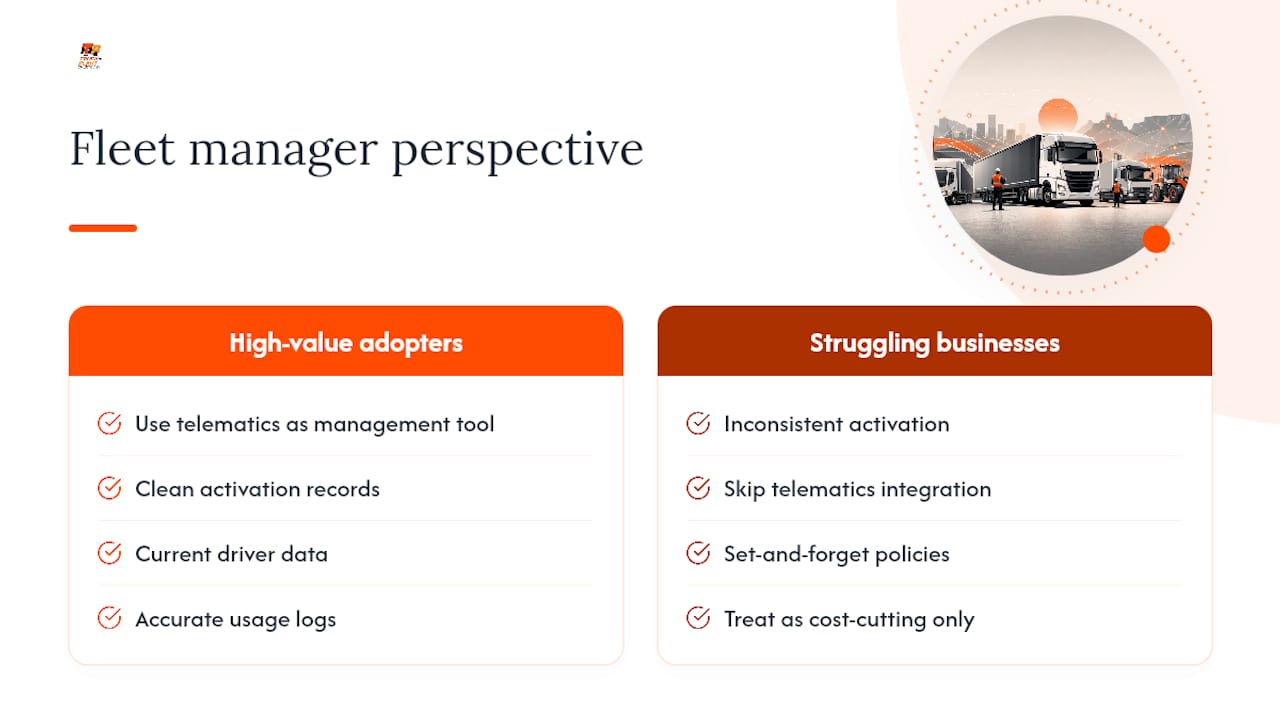
The case for on-demand cover is strongest when you approach it as an operational decision, not just a cost-cutting exercise. The businesses that extract the most value are those that treat telematics data as a management tool first and an insurance input second. When your activation records are clean, your driver data is current, and your usage logs are accurate, the insurer has everything needed to price fairly and settle claims quickly. The businesses that struggle are those that activate cover inconsistently, skip the telematics integration, or treat the policy as a set-and-forget product.
My recommendation: start with a pilot on your most clearly intermittent assets, get the data flowing, and review the numbers after eight weeks. The savings will either be obvious or they won’t, and you will know exactly why either way.
Truck & Plant On-Demand™: try hourly cover for your fleet
Paying a fixed annual premium for assets that spend weeks idle between projects is a straightforward cost that on-demand cover removes. Truck & Plant On-Demand™ fleet insurance gives you machine-level activation, telematics integration, comprehensive and fire-and-theft cover options, group personal accident, machinery breakdown, and environmental liability, all within a single platform built for civil, construction, and transport operations in South Africa.

Onboarding is processed within an hour when documentation is complete. Claims are authorised within 48 hours when documents are in order. To get started, request a quote or pilot proposal directly through the Truck & Plant On-Demand™ platform, where you can specify your asset list, telematics setup, and preferred cover types. Your fleet, your terms.
Sources
- DigitFMS — Insurance (article)
- How does telematics affect fleet insurance? | Cartrack ZA
- All Risk Insurance South Africa | Truck and Plant On‑Demand
- Engineering Plant Insurance South Africa | Truck & Plant On‑Demand
This article is general information, not a substitute for advice from a qualified financial advisor. Consult a qualified financial professional about your own circumstances before acting on anything here.