


Smart insurance is usage-aware, data-triggered commercial cover that automatically activates and settles claims when predefined, measurable events occur — no paperwork, no manual adjusters for straightforward losses. For fleet operators and plant hire businesses, that means paying only for cover when your assets are actually working, with faster claim settlement driven by objective sensor data rather than discretionary review.
Three things to know right now:
- Pay for when you use it. Premiums are tied to actual operational events, not a flat monthly rate regardless of utilisation.
- Faster settlement. When a policy trigger fires on verified data, payouts can occur without the usual claims filing chain.
- Telematics integration is required. Your devices must supply continuous, reliable data. Check compatibility before you commit to any pilot.
Immediate actions: confirm your telematics devices meet the sampling frequency your chosen provider requires, request sample trigger logic in writing, and ask Truckplant about a Truck & Plant On-Demand™ pilot for your fleet.
Table of Contents
- What is smart insurance, and how do the core components work?
- How smart insurance runs from activation to settlement
- What are the real benefits for fleet and plant hire operators?
- What risks and limitations should you plan for?
- How do you evaluate a smart insurance vendor before committing?
- How Truck & Plant On-Demand™ maps to fleet and plant use cases
- How to run a smart insurance pilot: checklist and timeline
- Key takeaways
- The integration gap is where most pilots stall
- Truckplant’s on-demand cover: built for fleets that don’t stand still
- Useful sources and further reading
What is smart insurance, and how do the core components work?
Smart insurance applies parametric insurance principles to commercial vehicles and plant machinery. Understanding the vocabulary helps you read product specs and contract language without confusion. Here are the key terms:
- Parametric trigger: A predefined, measurable condition that fires a policy action automatically — for example, an impact sensor reading above a set force threshold on a piece of excavation equipment.
- Oracle: An external data feed that supplies verified real-world information to the policy engine. Oracle quality is the single biggest variable in whether automation works correctly.
- Policy engine: The logic layer that evaluates incoming data against trigger rules and initiates a payout or escalation.
- Telematics: GPS and sensor hardware fitted to vehicles or plant that generates the continuous data stream the policy engine depends on.
- Smart contract (or partly automated policy): Policy terms encoded as executable logic. Most commercial deployments today are partly automated, retaining natural-language clauses and manual escalation paths for ambiguous losses.
The logical flow in plain terms: sensor or data feed → oracle validates and delivers data → policy engine evaluates against trigger thresholds → automated payout or escalation to adjuster → immutable audit trail recorded.
Three concrete trigger examples for fleets and plant:
- Idling time threshold: A truck idles beyond a defined period, triggering a usage-based premium adjustment.
- Geofence entry/exit for hire equipment: A telehandler leaves an authorised site boundary, automatically activating or deactivating hire cover.
- Impact sensor above force threshold: A loader registers an impact above a set G-force, initiating an automated damage assessment workflow.
For a broader look at fleet insurance terminology, Truckplant’s terminology guide covers the vocabulary procurement teams encounter in policy wording.
How smart insurance runs from activation to settlement
- Device and data setup. Telematics units are installed and configured to report at the sampling frequency your trigger logic requires. Mismatched cadence — devices sampling less frequently than a trigger needs — is a common pilot failure that causes missed events.
- Data ingestion and oracle validation. The policy engine receives data from the oracle. The oracle checks provenance and confirms the feed meets agreed quality standards before passing it on.
- Trigger evaluation. The engine compares incoming readings against predefined thresholds. A truck breakdown confirmed by engine-fault codes and GPS stop data, for example, fires the relevant trigger.
- Automated payout or escalation. For straightforward parametric events, funds transfer directly without a claims filing step. For ambiguous losses — a plant impact where cause is disputed — the system escalates to a human adjuster. Digital insurance platforms commonly use AI for fraud detection and pricing, but some scenarios still require human oversight.
- Audit trail. Every trigger event, data reading, and settlement is recorded on a tamper-resistant ledger, preventing duplicate claims and supporting dispute resolution.
For freight-specific claim flows, the freight insurance claim process at ForwarderOne explains how automation affects claim timelines in logistics contexts.

What are the real benefits for fleet and plant hire operators?
Pay-as-you-go pricing is the most immediate commercial advantage. You stop paying premiums on assets sitting idle in a yard. For plant hire businesses, geofence-based activation means cover switches on when equipment leaves your depot and off when it returns.
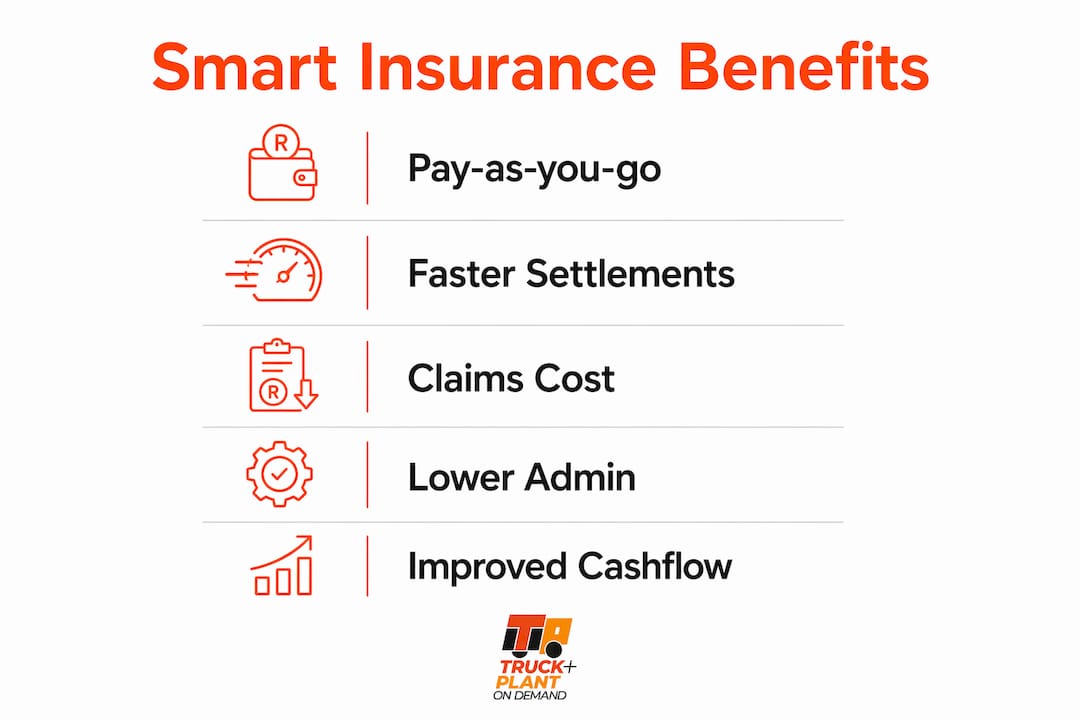
Faster settlements improve cashflow and reduce repair downtime. When the policy is triggered by objective data, payouts can occur without paperwork or discretionary decision-making — a direct operational benefit when a truck is off the road and a repair invoice is waiting.
| Benefit | Evidence |
|---|---|
| Claims cost reduction | Automation can reduce claims operating costs significantly in some analyses |
| Market growth | The global smart contract insurance market is projected to exceed $9 billion by 2032 |
| Admin savings | Removing manual adjusters for parametric events cuts approval chain overhead |
| Idle cover eliminated | Usage-based activation means premiums reflect actual asset deployment |
Lower admin cost compounds over a large fleet. Removing manual review from routine parametric events frees your risk team to focus on complex losses. For more on optimising fleet insurance premiums with flexible structures, Truckplant’s guide covers the pricing mechanics in detail.
What risks and limitations should you plan for?
Smart insurance is not risk-free. These are the failure modes that matter most in fleet and plant deployments:
- Bad oracle data. A faulty GPS unit or a dropped cellular connection produces incorrect readings. The policy engine executes on what it receives, not on what actually happened.
- Device malfunction. A telematics unit that stops reporting mid-shift creates a data gap. Define fallback procedures before you go live.
- Ambiguous trigger definitions. Vague threshold language leads to disputes. Request exact trigger definitions in writing, including grace periods and threshold buffers.
- Incorrect loss attribution. An impact event on a shared site may be attributed to the wrong asset if device IDs are not mapped correctly.
- Discretionary claims still apply. Total losses, liability disputes, and multi-party incidents typically require human adjudication regardless of automation level.
Pro Tip: Ask every prospective provider to document their oracle’s data provenance, SLA uptime commitment, sampling frequency, and fallback data source. Oracle quality is the primary risk control in any parametric policy — treat it as a contractual requirement, not a technical detail.
U.S. fleet operators should also confirm that their state insurance regulator accepts parametric trigger structures for commercial vehicle cover. Requirements vary by state; consult your broker or state insurance department before finalising policy terms.
How do you evaluate a smart insurance vendor before committing?
- Ask for exact data sources and oracle partners. Who supplies the data feed? What is their uptime SLA? What happens when the feed fails?
- Request sample trigger logic or policy code. You need to see the actual threshold definitions, not a marketing summary.
- Review the payout formula and exclusions list. Confirm what is excluded and under what conditions a parametric trigger is overridden.
- Confirm dispute resolution and auditability. How are contested triggers resolved? Can you access the raw data that fired a payout?
- Check data retention and privacy terms. Telematics data is sensitive. Confirm retention periods, access rights, and compliance with applicable U.S. data privacy requirements.
- Look for independent oracle partners, SOC audit documentation, and published pilot case studies. These are the trust signals that separate credible providers from unproven ones.
For a structured comparison of flexible cover options, Truckplant’s guide on comparing flexible fleet coverage walks through the evaluation criteria in practical terms.
How Truck & Plant On-Demand™ maps to fleet and plant use cases
Truck & Plant On-Demand™ is Truckplant’s on-demand cover product built specifically for commercial vehicles, trucks, trailers, and yellow plant machinery. Cover activates when you need it and switches off when you don’t — you control what is insured, when, and how.
Key feature-to-need mappings:
- Pay-per-use billing: Premiums reflect actual operational periods, not a fixed monthly rate.
- Geofence activation for hire equipment: Cover can be tied to site boundaries, supporting plant hire businesses that move equipment between locations.
- Automated payout options: Straightforward parametric events settle without manual claims filing.
- Additional products: Group personal accident, environmental liability, machinery breakdown, and general business liability cover are available alongside core vehicle cover.
When you request a demo, cover these topics: trigger logic walkthrough with your actual asset types, sample SLA for oracle data feeds, telematics onboarding process and device compatibility check, and a settlement audit trail demonstration with a sample loss event.
How to run a smart insurance pilot: checklist and timeline
- Select your pilot fleet. Choose 5–20 assets with existing telematics already installed and reporting reliably.
- Confirm telematics compatibility. Verify that your devices meet the provider’s required sampling frequency and data format. Reliable telematics are a non-negotiable prerequisite for parametric triggers.
- Define trigger logic in writing. Agree exact thresholds, grace periods, and fallback rules before signing anything.
- Sign a short pilot policy. A 60–90 day pilot period is typical. Run it in parallel with your existing cover initially.
- Run parallel validation. Compare automated trigger outcomes against your own incident records for the first 30 days to catch data cadence mismatches early.
- Evaluate results against KPIs. Measure settlement speed, percentage of automated payouts, downtime reduction per triggered event, and cost per mile covered.
- Review and scale. Use the pilot data to refine trigger thresholds before expanding to your full fleet.
Typical timeline: onboarding and integration takes 2–4 weeks; the active trial runs 60–90 days; a formal review follows with a decision on full deployment. For proven steps to cut fleet insurance costs, Truckplant’s guide covers the premium levers you can pull once a pilot confirms your baseline.
Key takeaways
Smart insurance reduces fleet operating costs and claims admin by replacing manual processes with data-triggered automation, but the model only performs as well as the telematics and oracle feeds that power it.
| Point | Details |
|---|---|
| Pay only for active cover | Usage-based activation eliminates premiums on idle assets, directly reducing fleet insurance spend. |
| Oracle quality is the primary risk | Flawed data feeds produce flawed payouts; treat oracle SLAs as a contractual requirement. |
| Pilot before scaling | A 60–90 day parallel validation period catches data cadence mismatches before full deployment. |
| Human adjudication remains | Ambiguous losses, liability disputes, and total losses still require manual review regardless of automation level. |
| Truck & Plant On-Demand™ | Truckplant’s on-demand product activates cover by asset and period, with geofence and parametric options for commercial fleets and plant hire. |
The integration gap is where most pilots stall
The promise of smart insurance is real. Faster settlements, lower idle cover costs, and auditable claim records are genuine operational gains for fleet and plant hire businesses. The part most articles skip is that none of it works without clean, continuous, correctly sampled telematics data.
In practice, the integration step is the primary gating factor. Devices that report every 60 seconds may not be granular enough for a trigger that needs 10-second impact readings. That mismatch is invisible until you run a parallel validation period and compare automated outcomes against your own incident log.
The practical lesson: start with conservative trigger thresholds and a limited pilot fleet. Increase automation only after you have confirmed that your data feeds and oracle outputs match real-world events consistently. Providers who resist showing you raw trigger data during a demo are telling you something important.
Truckplant’s on-demand cover: built for fleets that don’t stand still
If you run commercial vehicles or plant machinery and you’re still paying a flat monthly premium regardless of how much your fleet actually works, Truck & Plant On-Demand™ is the direct alternative. You pay for cover when your assets are active, change your cover as your operations change, and manage everything without locking into a rigid annual policy.
Truckplant designed Truck & Plant On-Demand™ specifically for the civil, construction, and transport industries — owner-operators, hire companies, and large fleet operators alike. Cover includes commercial vehicles, trucks, trailers, and yellow plant machinery, with optional group personal accident, environmental liability, and machinery breakdown products available alongside core cover.
The next step is straightforward: check your telematics compatibility, prepare your pilot fleet list, and request a pilot to see Truck & Plant On-Demand™ working against your actual asset types and operational patterns.
Useful sources and further reading
- Smart contract insurance explained | Stripe — Covers encoded policy logic, oracle data feeds, trigger evaluation, automatic payout flow, and immutable recordkeeping. Used for automation speed, audit trail, and market growth claims.
- Smart contracts in insurance | Norton Rose Fulbright — Legal and industry analysis of partly automated versus fully self-executing contracts, oracle quality as primary risk control, and telematics compliance requirements. Used for oracle validation guidance and regulatory framing.
- Digital insurance: everything you need to know | SmartFinancial — Explains AI-driven underwriting, claims automation, and the scenarios that still require human adjudication. Used for claims cost reduction data and hybrid model explanation.
- Freight insurance claim: what shippers need to know | ForwarderOne — Practical explanation of how automation affects claim timelines in freight and logistics contexts.
- Fleet insurance terminology | Truckplant — Terminology primer for procurement teams reviewing smart insurance policy wording.
- Compare insurance options for flexible fleet coverage | Truckplant — Evaluation criteria and checklist for comparing flexible and on-demand fleet cover providers.
This article is general information, not legal, regulatory, or insurance advice. Confirm current rules and policy terms with a licensed broker or your state insurance department for your specific situation.