


Adjusting your fleet and plant insurance monthly aligns your cover to actual exposure, protects cash flow, and often reduces total premium spend when paired with proper risk controls. You stop paying full premiums for idle trucks, parked excavators, or seasonal drivers who aren’t on the road.
The direct recommendation: adopt on-demand, usage-based cover for any fleet or plant asset with fluctuating activity, and keep minimum baseline limits in place for legal and regulatory compliance. This isn’t a workaround. It’s how commercial insurance is heading.
Three data points make the case immediately:
- Insurance averaged 10.2 cents per mile in 2024 according to ATRI-referenced industry reporting, with increases continuing into 2025 and 2026.
- Usage-based commercial auto policies reached roughly 22% of new commercial auto policies in 2025, per industry telematics reporting.
- Products like Truck & Plant On-Demand™ now let operators bind and adjust cover in real time, matching premium to actual asset exposure rather than a fixed annual estimate.
Key Takeaways
Monthly, usage-based insurance adjustment cuts overinsurance, improves cash flow, and works best when paired with telematics-backed risk controls and documented governance.
| Point | Details |
|---|---|
| Cost alignment | Paying only for active exposure avoids subsidising idle trucks or parked plant machinery. |
| Watch operational triggers | Adjust cover at project start/finish, seasonal layups, and route redeployment, not on a fixed calendar. |
| Telematics drives discounts | Shared telematics data can earn 8% to 25% premium credits, typically applied at renewal. |
| Document every change | Signed authorisation and timestamped telematics records protect you if a claim arises during adjusted cover. |
| Pilot before scaling | Truck & Plant On-Demand™ lets fleets test real-time adjustable cover on one depot before rolling out fleet-wide. |
Table of Contents
- Why adjust insurance monthly: the business case
- What operational triggers should prompt a cover change?
- How are commercial insurance premiums actually calculated?
- Which risk-management tools make monthly adjustment safer?
- How do you implement monthly adjustable cover step by step?
- What pitfalls and compliance issues should you watch for?
- What does a monthly adjustment actually save in practice?
- Should you pilot monthly adjustment, and how do you start?
- Get monthly adjustable cover built for your fleet
- Sources
Why adjust insurance monthly: the business case
Monthly adjustment is fundamentally a cost-alignment exercise. Annual policies price your fleet on assumed average utilisation. If half your plant machinery sits idle for three months of the year, you’re still paying full premium on it. Usage-based cover flips that: you pay for exposure as it happens.

That matters more in 2026 than it did five years ago. Insurers are tightening capacity and raising rates because of higher accident frequency, rising repair costs, and fewer profitable carriers underwriting commercial risk. Construction accounts in particular have seen premium increases as steep as 22% in some segments during 2026, according to Buildermuse’s coverage of the sector. In that environment, paying for cover you don’t need isn’t just wasteful. It’s a margin problem.
Monthly adjustment also smooths cash flow. Annual lump-sum premiums hit your balance sheet as one large outflow, often timed badly against your actual revenue cycle. Spreading cost to match usage means your insurance spend tracks your income, not a renewal date set by your broker’s calendar.
Statistic to watch: embedded, on-demand insurance has scaled into a market worth roughly $7.2 billion in 2024, with quotes returning in under 60 seconds through API-based binding. That growth reflects a real shift in how commercial operators want to buy cover.
The businesses that benefit most:
- Plant and tool hire companies with seasonal demand swings.
- Construction contractors moving between project sites and layup periods.
- Fleet operators using subcontracted or casual drivers on short notice.
- Transport businesses redeploying trailers or trucks across regional demand spikes.
For a deeper breakdown of how flexible pricing compares with fixed annual policies, see this guide on comparing insurance options for flexible fleet coverage.
What operational triggers should prompt a cover change?
You don’t adjust cover on a whim. Certain operational events should trigger a review every time, and building this into your standard operating procedure keeps the process disciplined rather than reactive.
- Project start or finish — bind additional plant or vehicle cover the day a contract is signed, and release it the day the job closes out.
- Seasonal layups — reduce cover on equipment mothballed over winter or off-season, keeping only fire, theft, and liability minimums active.
- Rental days versus idle days — for plant hire, track utilisation rates weekly; a machine sitting unrented for 30+ days is a strong signal to downgrade cover tier.
- New hires or subcontractor usage — any new driver or operator using company assets needs a documented cover check before their first shift.
- Lease or loan changes — financed assets often carry lender-mandated minimum cover; confirm this before reducing anything.
- Route or asset redeployment — moving a truck from a low-risk regional route to a high-traffic corridor changes your risk profile immediately.
Each trigger needs a quick verification step: who authorises the change, what documentation supports it (a signed contract, a rental agreement, a dispatch log), and how long the adjusted cover should run before automatic review.
Pro Tip: Never let baseline cover drop below your statutory minimum, even during a layup. A one-day gap in third-party liability cover can void a claim entirely if an incident happens during that window, even if the asset was “off the road” at the time.
How are commercial insurance premiums actually calculated?
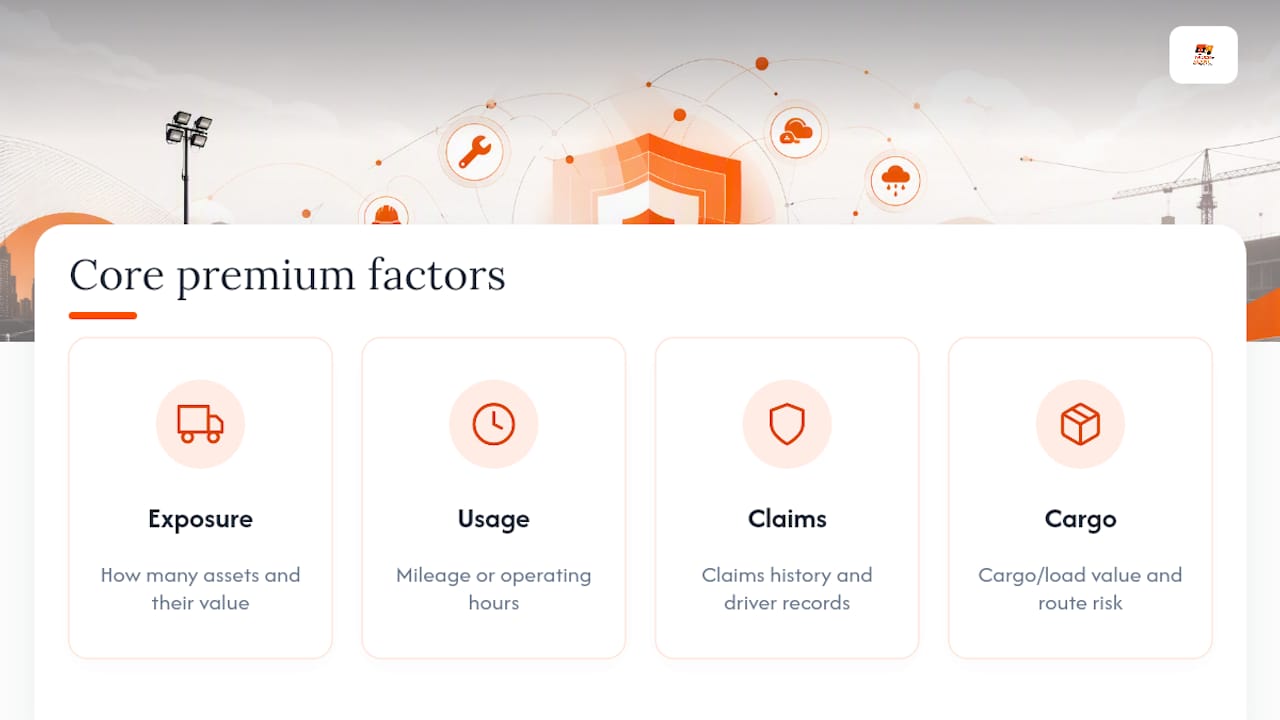
Premiums aren’t set on gut feeling. Insurers price commercial fleet and plant risk using a handful of core variables: vehicle or unit exposure (how many assets, how much they’re worth), mileage or operating hours, claims history, driver records, cargo or load value, and route risk.
Monthly adjustment changes the insurer’s real-time read on your exposure. When you tell a carrier you’re running five trucks this month instead of eight, you’re not asking for a discount. You’re giving them updated information that changes what they’re actually underwriting. That’s a meaningfully different conversation than negotiating a blanket annual rate down.
Two things to understand about timing. First, insurers are under real pressure right now. Rising accident frequency and repair costs are pushing commercial auto rates upward across 2026, so even usage-based cover isn’t immune to base-rate inflation. Second, telematics-linked discounts usually apply at renewal rather than instantly. Usage-based insurance adoption reached about 22% of new commercial auto policies in 2025, but carriers typically need a data collection period before applying behaviour-based credits. Expect this month’s safe driving to show up in next quarter’s pricing, not this week’s invoice.
Repair cost inflation deserves a mention here too, since it’s a direct driver of rising premiums. Fleet managers weighing repair against replacement decisions can find useful context in Premier Fleet Repair’s breakdown of repair versus replacement economics, which explains why claims costs keep climbing even as vehicle safety technology improves.
Which risk-management tools make monthly adjustment safer?
Insurers will only offer flexible, usage-linked pricing if you can prove your risk profile in real time. That proof comes from a specific stack of tools and processes, not from a phone call to your broker.
- Telematics sharing — continuous GPS, speed, and braking data gives carriers objective evidence of how assets are actually used.
- AI dashcams — footage-based systems that flag following distance, harsh braking, and speeding help insurers attribute blame accurately and support behaviour coaching. Insurers increasingly value this kind of dashcam evidence for both claims resolution and premium negotiation.
- ADAS features — collision warning, lane departure alerts, and automatic braking reduce claim frequency, which insurers reward over time.
- Driver vetting and MVR checks — a documented hiring and training process reduces the underwriting uncertainty that pushes premiums up.
- Load and route documentation — proof of what’s being carried and where reduces disputes during claims and supports faster cover changes.
Carriers that receive shared telematics data commonly offer premium credits in the 8% to 25% range for strong aggregate driving behaviour. That’s a meaningful lever, but it depends on consistent, clean data over time, not a single good month.
Pro Tip: Pair your governance process with your technical evidence. If your finance director approves a cover reduction, but you can’t produce a timestamped telematics log proving the asset was actually idle, an auditor or claims adjuster has grounds to challenge the change after the fact. For technical detail on integrating telematics with your policy, see Truckplant’s guide to telematics in fleet insurance.
How do you implement monthly adjustable cover step by step?
Moving from annual blanket cover to monthly adjustable cover is a project, not a switch you flip overnight. Here’s the sequence that works.
- Review current exposures. Audit which vehicles and machinery sit idle, seasonally underused, or overinsured relative to actual activity. Fleet managers typically own this step, working from utilisation logs.
- Set minimum statutory limits. Confirm with your broker or risk manager what third-party and liability minimums you cannot drop below, regardless of usage.
- Select an on-demand or usage-based product. Compare providers against your actual asset mix, not a generic annual quote.
- Integrate telematics or TMS data feeds. IT and fleet operations should connect tracking systems to whatever platform manages your cover changes.
- Define an approval workflow. Decide who can authorise a cover increase or decrease, and require sign-off documentation for every change.
- Pilot on one depot or project. Run the new model on a contained scale for 60 to 90 days before rolling out fleet-wide.
- Review metrics before scaling. Measure premium spend, claims per mile, and cash-flow impact against your old annual model before expanding further.
Finance should track the cash-flow delta directly; risk management should track claims frequency. If both improve during the pilot, scale it. If either worsens, diagnose before expanding. Practical tactics for tightening this process further are covered in Truckplant’s guide to reducing fleet insurance premiums.
What pitfalls and compliance issues should you watch for?
Flexible cover isn’t risk-free. Several traps catch operators who move too fast or skip documentation.
- Minimum premium floors — some policies carry a monthly minimum regardless of usage, which can erode the savings you expected.
- Mid-term audit clauses — insurers may audit declared exposure against actual usage; undocumented changes can trigger disputes or clawbacks.
- Coverage exclusions — certain commodities, routes, or equipment types may be excluded from standard usage-based products; always check the policy wording before assuming a new asset is covered.
- Binding lag — there’s often a delay between requesting a cover change and it actually taking effect; never assume same-day binding unless your provider explicitly guarantees it.
Documentation is your protection against all of the above. Keep signed authorisation records, TMS logs, and telematics snapshots for every cover change you make. If a claim arises during a period of adjusted cover, that paper trail is what determines whether the insurer pays out. This isn’t optional bookkeeping. It’s the evidence base your entire flexible cover strategy rests on. For a regional view on managing these compliance points, see Truckplant’s cost-saving insurance strategies.
What does a monthly adjustment actually save in practice?
Consider a plant hire company running 20 excavators. Under a traditional annual policy, all 20 units are insured at full value year-round, regardless of rental activity.

Under an on-demand model, you drop cover on those 8 units to a minimal storage tier during that period and reinstate full cover when a rental books.
The breakeven point depends on how often you’re reinstating cover. If you’re flipping assets on and off cover weekly, administrative friction and any minimum monthly fees can erode the savings. On-demand cover works best when utilisation shifts happen in blocks of weeks or months, not days. If your fleet swings hour to hour, a usage-based per-load model, which some carriers now bind via API in under 60 seconds, fits better than a monthly toggle.
Should you pilot monthly adjustment, and how do you start?
Mandatory baseline controls before you start: statutory minimum liability cover locked in permanently, a documented approval workflow, and at minimum basic telematics tracking on the assets you plan to adjust.
Immediate next steps:
- Contact your broker and ask specifically about usage-based or on-demand products, not just annual renewal quotes.
- Choose one depot, project, or asset category as your pilot group.
- Enable telematics data sharing with your chosen carrier before the pilot starts, not after.
- Run a 90-day pilot and compare premium spend, claims frequency, and cash flow against the prior annual model.
Truck & Plant On-Demand™ is built specifically for this use case. It gives fleets and plant hire operators real-time control over what’s insured, when, and at what level, without waiting for a renewal cycle to correct a mismatch between cover and actual exposure.
A practitioner’s view on making monthly adjustment work
Governance is where most flexible cover programmes succeed or fail. It’s not the technology that trips people up. It’s the human step of deciding who can pull the trigger on a cover change and whether that decision gets recorded properly. Fleets that treat this casually, with a verbal “just drop cover on that truck” from an ops manager, end up with disputes when a claim lands during an undocumented gap.
Broker coordination matters more than most operators expect going in. A broker who understands usage-based products can move quickly when you need a change bound; one who’s only used to annual renewals will slow you down at exactly the moment speed matters. Staff training is the quieter piece. Drivers and site supervisors need to understand that reporting idle time or route changes isn’t paperwork for its own sake. It’s the data that keeps their cover accurate and their premiums fair.
Carriers respond well to demonstrated risk controls, but only when the evidence is consistent. A single month of clean telematics data doesn’t move pricing. A sustained pattern, backed by timestamped records an insurer can independently verify, does. That’s the shift in thinking that takes longest to embed: from managing insurance once a year to managing it as a live operational input, month over month.
Get monthly adjustable cover built for your fleet
Truckplant built Truck & Plant On-Demand™ because paying the same premium every month, when your operational exposure changes constantly, never made sense. Traditional annual policies force you to guess your utilisation twelve months out and pay for that guess whether it holds true or not. On-demand cover lets you switch assets on and off cover in real time, so your premium tracks what you’re actually running, not what you estimated in January.

Whether you’re an owner-run plant hire business or one of the larger fleet operators on the road, you choose what’s insured, when, and how, through a digital platform designed for the pace of construction, civil, and transport work. If you’re weighing a pilot after reading this, the practical next step is straightforward: visit the Truck & Plant On-Demand™ fleet insurance page and get a quote for the specific vehicles or machinery you want to bring onto flexible cover first.
Sources
- What Fleets Can Do About Rising Insurance Costs in 2026 – TT
- Embedded Per-Load Insurance: How On-Demand Freight Coverage Is Replacing Annual Cargo Policies in 2026 | CXTMS
- Usage Based Insurance Technology
- Construction insurance costs surge 22% in 2026: Control premiums | Buildermuse
This article is general information, not a substitute for advice from a qualified financial advisor. Consult a qualified financial professional about your own circumstances before acting on anything here.