


Adjustable cover, the industry term for on-demand, usage-based insurance (UBI), lets you pay only for the protection you actually use, which means your premium tracks real exposure rather than a fixed annual estimate. Fleets using high-fidelity telematics commonly report average annual premium savings of 15–20% when underwriters accept that data. Cashflow improves because you are not prepaying twelve months of cover for assets that sit idle half the year. Truck & Plant On-Demand™ by Truckplant is built on exactly this premise: you choose what to insure, when to insure it, and how, so every dollar of premium is working.
Key takeaways
Adjustable, on-demand insurance is the most cost-efficient structure for fleets and plant hire operations with variable utilisation, and high-fidelity telematics is the mechanism that unlocks the best pricing.
| Point | Details |
|---|---|
| Who benefits most | Seasonal fleets, plant hire operators, short-contract transport, and rental businesses with variable asset utilisation. |
| Expected savings range | Fleets with clean telematics data commonly achieve 15–25% premium reductions; coaching reduces at-fault claims by 20–35% in year one. |
| Telematics fidelity requirement | Use devices with high GPS sampling rates and accelerometer detail; basic ELD-only units limit the discount band available. |
| 90-day readiness window | Audit assets, install devices, run coaching, and clean 90 days of data before submitting to underwriters. |
| Truckplant next step | Truck & Plant On-Demand™ binds adjustable cover digitally with telematics integration for fleets and plant hire of any size. |
Table of Contents
- What does “adjustable cover” actually mean for fleets and plant hire?
- How usage-based insurance works: telematics, pricing models, and data
- The business case: quantified savings and operational benefits
- How to choose and implement adjustable cover for your fleet
- When adjustable cover isn’t the right fit, and U.S. compliance considerations
- How Truck & Plant On-Demand™ delivers adjustable cover
- Why Truckplant recommends adjustable cover for every qualifying fleet
- Truckplant: adjustable cover built for your operations
- Sources
What does “adjustable cover” actually mean for fleets and plant hire?
Adjustable cover is on-demand, usage-based insurance that you can increase, reduce, or toggle in real time to match your actual exposure across commercial vehicles, trailers, plant machinery, and hired tools. Unlike a fixed annual policy, it does not lock you into a single coverage level for twelve months.
Coverage typically spans:
- Liability (third-party bodily injury and property damage, including MCS-90 endorsements for interstate motor carriers)
- Physical damage (collision and comprehensive for trucks, trailers, and yellow plant)
- Cargo endorsements (on-demand activation for loads in transit)
- Hired and non-owned coverage (rented or borrowed assets not on your permanent schedule)
- Short-term add-ons (machinery breakdown, tools and equipment, environmental liability)
Short-term commercial vehicle insurance is purpose-built for exposures from one day to six months, with daily or weekly pricing that avoids the short-rate penalties you incur when cancelling an annual policy early. That makes it the natural fit for short contracts, seasonal fleets, rented or borrowed assets, newly-authorised motor carriers, and ad-hoc plant hire where annual cover would be wasteful.
How usage-based insurance works: telematics, pricing models, and data
Adjustable cover is priced using telematics-driven risk measures, with your premium calculated against a base rate or per-use charge that moves as your data moves.
Device types and data sources
Carriers accept data from OBD-II dongles, CAN bus integrations, purpose-built fleet telematics units, and dash cams with embedded sensors. The specific metrics underwriters score include mileage, hard braking events, rapid acceleration, cornering force, speed profiles, idle time, seatbelt usage, and time-of-day patterns. Accelerometers and gyroscopes capture event severity; GPS ties every event to a route and time stamp.
The data flow
Device captures event → encrypted transmission to telematics platform → analytics engine scores driver behaviour → underwriter model ingests the score → premium adjusts at the agreed cadence (monthly, quarterly, or at renewal).
Pricing model options
- PAYD (Pay As You Drive): premium scales with verified mileage; lower mileage, lower cost.
- PHYD (Pay How You Drive): premium adjusts based on driving behaviour scores, not just distance.
- PAYG (Pay As You Go): cover activates per trip, per day, or per asset deployment, with no charge when the asset is off-road.
Why device fidelity matters
Basic ELD-only systems often lack the sampling rate and event granularity underwriters want. A device logging GPS at 2 Hz misses the braking signature a 10 Hz unit captures clearly, which limits the discount band available to your fleet. Telematics in fleet insurance explains the integration requirements in detail.
Pro Tip: Ask any telematics vendor for their GPS sampling rate and accelerometer resolution before purchasing. Underwriters increasingly specify minimum thresholds, and a cheap device can disqualify you from the best pricing tiers.
The business case: quantified savings and operational benefits
Fleets that qualify for UBI programs typically see material premium reductions. Treating telematics data as a transparency dividend and preparing three months of cleaned data before renewal commonly yields premium reductions often between fifteen and twenty-five percent, with high-performing fleets reaching higher savings depending on carrier appetite.
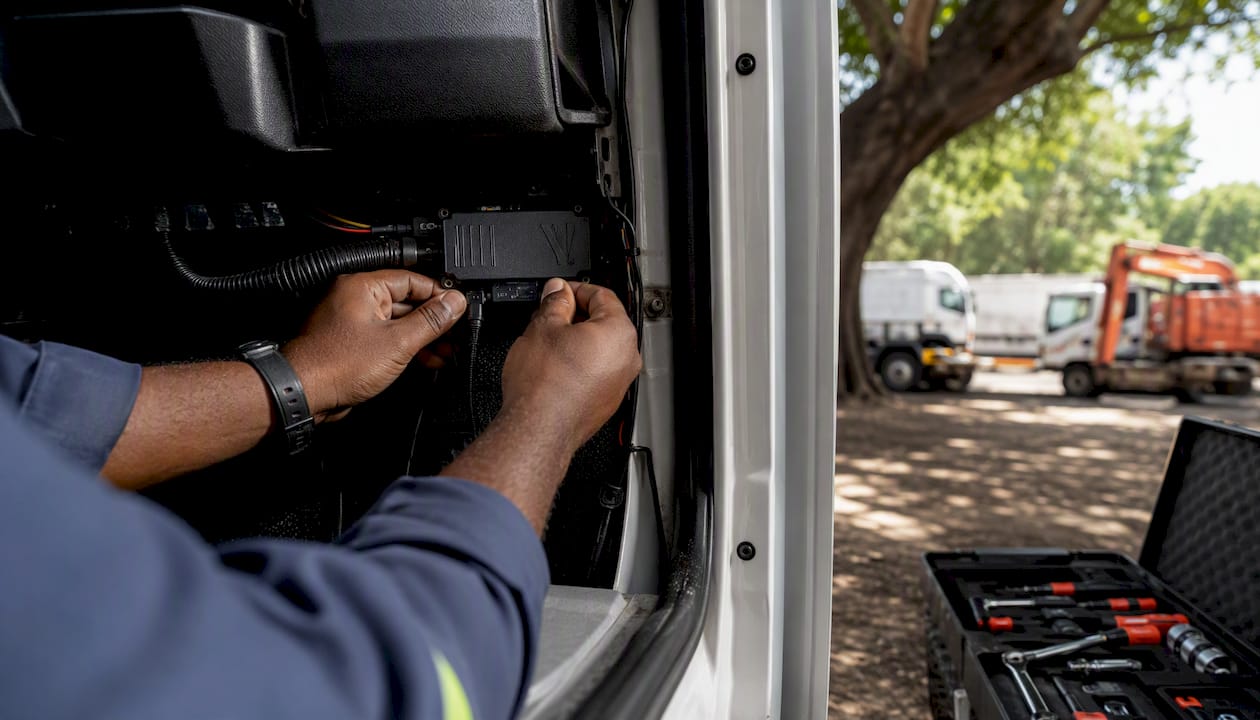
Three benefit categories compound over time:
1. Direct premium discounts
UBI programs price your risk on demonstrated behaviour, not actuarial averages. A fleet with clean telematics data pays less than a comparable fleet with no data, because the carrier can see the risk rather than estimate it.
2. Long-term loss-run improvement
Telematics-driven coaching reduces at-fault collisions by between twenty and thirty-five percent in the first year in many documented programs. Fewer at-fault claims clean up your loss run, which compounds into lower base rates at every subsequent renewal. This long-term effect often exceeds the headline UBI discount.
3. Cashflow and operational flexibility
Pay-as-you-go billing replaces a large annual prepayment with charges that match actual use. Seasonal fleets, rental fleets, and short-contract operations benefit most: you are not carrying the cost of cover for assets sitting in a yard. Seasonal and route-based operational changes can reduce segment-level exposure further, with documented premium improvements ranging from low single digits to the mid-teens on affected routes.
Secondary benefits include faster theft recovery through GPS tracking, quicker digital claims handling, and better equipment utilisation data that informs your own dispatch decisions. For plant hire operators, knowing exactly when each unit was active also simplifies billing reconciliation.
How to choose and implement adjustable cover for your fleet
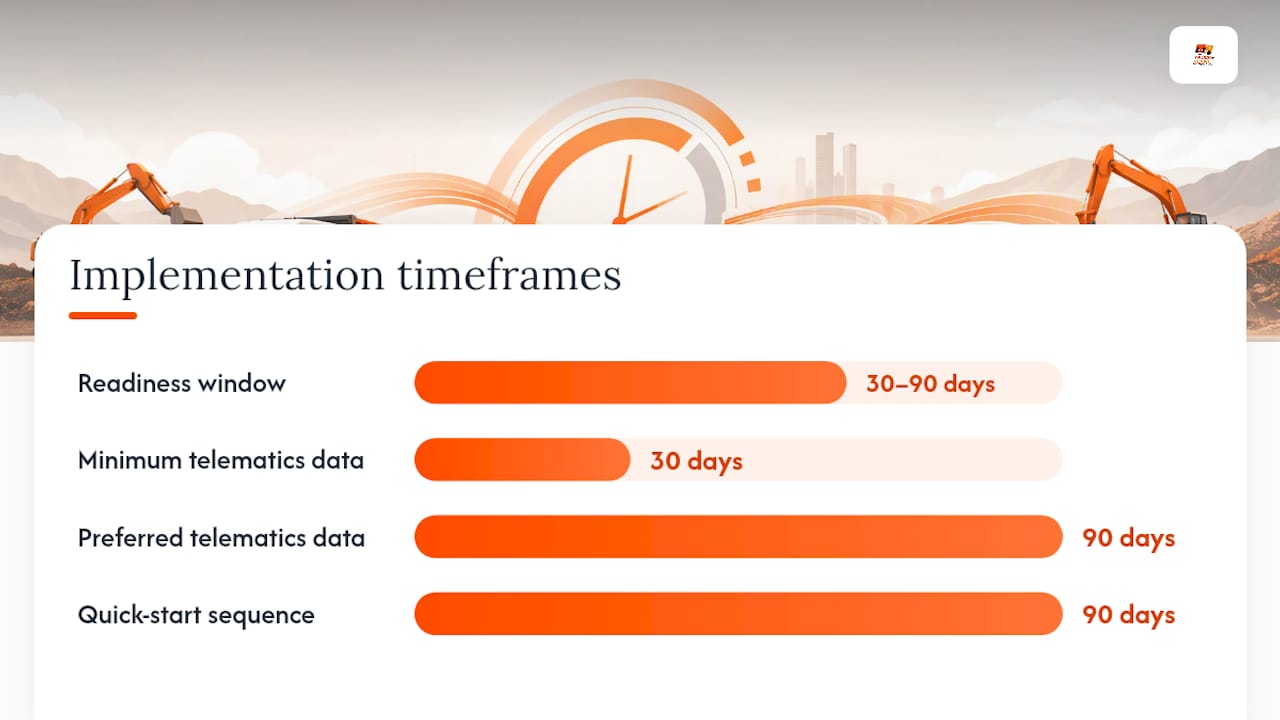
Implementation is procedural and typically fits into a 30–90 day readiness window when you are prepared.
Readiness checklist
- Complete asset register (VINs, equipment serial numbers, current coverage limits)
- Telematics devices installed and transmitting on all units to be covered
- Minimum 30 days of clean telematics data (90 days preferred for renewal negotiations)
- Driver consent documentation in place (required for data collection)
- Data security and retention policy agreed with your telematics vendor
- Driver coaching program activated to begin improving behaviour scores
- Broker briefed on your UBI program and target carriers
Implementation timeline
Questions to ask insurers and brokers
- Which telematics devices and platforms do you accept?
- What is the minimum data history required for UBI pricing?
- How often does the premium adjust, and what triggers a mid-term change?
- How are rebates or credits calculated and when are they applied?
- What lookback window do you use for loss-run assessment?
Red flags: a carrier that cannot name approved devices, offers no mid-term adjustment mechanism, or cannot explain its scoring methodology is unlikely to deliver genuine UBI pricing. Optimising fleet insurance premiums with verified data is the standard expectation from credible programs.
90-day quick-start sequence
- Audit your asset register and identify untracked units.
- Install or upgrade telematics devices to meet underwriter specifications.
- Activate driver coaching and set measurable behaviour targets.
- Pull and clean 90 days of telematics reports.
- Brief your broker, request UBI-capable carriers, and submit data for indicative pricing.
When adjustable cover isn’t the right fit, and U.S. compliance considerations
Adjustable cover is not universal. High-risk operations, including hazmat transport, oversized or overweight loads, and fleets with poor driving records or frequent at-fault claims, may be excluded from standard UBI programs or require specialty terms through surplus-lines carriers. If your loss run shows multiple large claims in the past three years, carriers may decline to price on telematics alone until the record improves.
U.S. regulatory touchpoints
- ELD/FMCSA: Electronic Logging Device rules under FMCSA mandate apply to most commercial motor vehicles in interstate commerce. Your telematics vendor must confirm that their device does not interfere with ELD compliance and that data collected for insurance purposes is handled separately from HOS records.
- MCS-90 endorsement: Interstate motor carriers are required to carry this endorsement as a condition of operating authority. Confirm your adjustable cover policy includes or accommodates MCS-90 where applicable.
- State-level requirements: Minimum liability limits vary by state. Verify that your on-demand policy satisfies the requirements of every state in which your vehicles operate.
Privacy and data security
Demand written confirmation from your telematics vendor that driver data is encrypted in transit and at rest, that retention periods are defined and limited, and that data is not sold to third parties. Driver consent must be documented before collection begins. Fleet insurance strategies that include a data governance framework are increasingly a carrier expectation, not just a best practice.
One-sentence red flags from carriers: unverifiable telematics data, missing encryption certificates, incomplete asset coverage on the schedule, or a vendor that cannot produce a data processing agreement on request.
How Truck & Plant On-Demand™ delivers adjustable cover
Truck & Plant On-Demand™ implements adjustable cover with pay-for-usage billing, telematics acceptance, and rapid digital binding tailored to construction, plant hire, and fleet operations of any size.
Key product features:
- Real-time adjustable limits: activate, increase, or reduce cover per asset as your operations change
- Digital claims management: report and track claims through the platform without paper forms
- Telematics integration: accepts data from approved devices to support UBI pricing
- Rental software integration: tool hire businesses can link cover activation directly to rental dispatch
- Optional endorsements: cargo, machinery breakdown, environmental liability, and group personal accident
How to get started
- Create your Truckplant account and register your assets.
- Select your telematics integration or upload verified telematics reports.
- Choose your cover type and limits per asset.
- Request a pilot quote and review the UBI pricing terms.
- Bind cover digitally and activate your dashboard.
Pro Tip: Register all assets, including those currently idle, so you can activate cover instantly when a unit goes back into service. Gaps in the asset register are the most common cause of uninsured exposure in on-demand programs.
Truckplant’s on-demand cover guide explains how switching from a fixed annual policy to adjustable cover protects your fleet and reduces wasted premium.
Why Truckplant recommends adjustable cover for every qualifying fleet
The fleets that benefit most from adjustable cover are not necessarily the largest. They are the ones with variable utilisation: seasonal operations, plant hire businesses that deploy equipment in bursts, and transport companies running short contracts alongside long-haul work. For those operations, a fixed annual premium is structurally inefficient because it prices the worst-case exposure for the full year, regardless of what actually happens. Adjustable cover prices what you actually do. Combined with a disciplined telematics and coaching program, it converts operational data into a direct financial return at renewal. That is the case Truckplant was built on, and it holds across fleet sizes and asset types.
Truckplant: adjustable cover built for your operations

If your fleet or plant hire business carries assets that are not working every day of the year, a fixed annual policy is costing you money you do not need to spend. Truck & Plant On-Demand™ gives you real-time control over your cover, so you pay for protection when your assets are active and stop paying when they are not. It accepts telematics data from approved devices, integrates with rental dispatch software for tool hire businesses, and binds cover digitally without the paperwork of a traditional policy. Whether you run three trucks or three hundred pieces of plant, the cover adjusts to your operations, not the other way around. Get a quote for on-demand fleet cover and see what your fleet should actually be paying.
Sources
- Telematics insurance savings: fleet breakdown
- Using telematics data to lower insurance premiums: a 2026 fleet strategy
- Temporary commercial vehicle insurance: short-term coverage
- Seasonal and route-based pricing hacks: reducing premiums through operational changes
- Why your fleet insurance might be lower with GPS tracking