


TL;DR:
- Ad hoc insurance provides temporary, project-specific coverage for businesses with variable operational needs. It allows companies to pay only for active periods, reducing unnecessary costs compared to annual policies. Proper underwriting, classification, and documentation are essential for effective and compliant use.
Ad hoc insurance cover is defined as temporary, project-specific protection purchased for a defined period or operational need rather than as a continuous annual policy. The term comes from the Latin phrase meaning “for this,” and in business it describes actions taken for a specific, short-term purpose before concluding. For civil, construction, and transport businesses, this distinction matters enormously. Your operations are not uniform. A road-building contract runs for six weeks. A crane is hired for one job. A fleet of trucks sits idle between tenders. Paying a fixed annual premium for coverage you only need intermittently is a direct cost leak. Tailored insurance coverage that activates when risk exists and switches off when it does not is the smarter alternative. Truckplant’s Truck & Plant On-Demand™ was built on exactly this premise.
What types of ad hoc insurance cover exist for construction and transport?
The short-term insurance market offers several distinct product types for businesses with variable operational needs. Understanding which product fits which situation is the first practical step.
- Short-term equipment hire insurance: Coverage periods from 1 week to 12 months on an all-risks basis, tailored to the duration of a specific project. This suits a civil contractor who hires an excavator for a bridge foundation job and needs cover only for that contract window.
- Short-term liability insurance: Coverage ends after the term unless renewed, making it suitable for project-specific public liability or contractor’s liability needs. The key distinction here is whether the policy is written on a claims-made or occurrence basis, which affects when a claim must be lodged.
- Plant and machinery insurance: Policies adjust durations to match hire-contract periods, covering both owned and hired equipment. A transport company that brings in additional yellow plant for a seasonal earthworks contract can insure that equipment precisely for the hire term.
- Temporary vehicle insurance: Coverage windows as short as 1 hour up to 28 days demonstrate the pay-for-need mechanics that define ad hoc cover. This applies directly when a transport business adds a vehicle to its fleet temporarily for a peak-demand period.
- Surplus lines placements: For risks that standard admitted carriers will not cover, brokers can place cover through non-admitted markets. This is a legitimate and regulated route, but it carries specific compliance requirements discussed in the next section.
Pro Tip: When hiring plant or equipment, confirm with your broker whether the policy covers the hired item as a standalone risk or only as an extension of your existing fleet policy. The difference affects your claims response significantly.
Each of these products serves a different trigger point. The right choice depends on whether you own or hire the equipment, how long the operational window lasts, and what liability exposure the project creates.
How does ad hoc cover compare to traditional annual insurance?
The core operational difference between ad hoc and annual insurance is cost alignment. Annual policies charge a fixed premium regardless of whether your equipment is active, idle, or off-site. On-demand insurance reduces unnecessary premium spend for businesses with fluctuating operations. That saving is real and measurable when you manage a fleet that sits dormant between contracts.
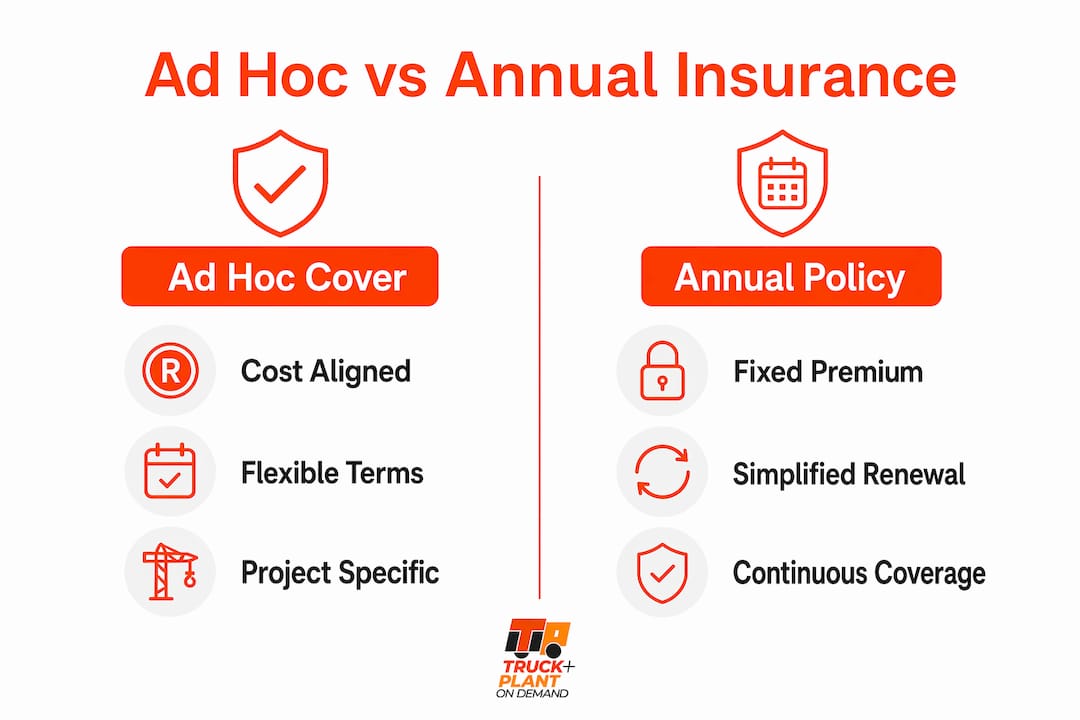
| Aspect | Ad Hoc Insurance Cover | Traditional Annual Policy |
|---|---|---|
| Premium structure | Pay only for active coverage periods | Fixed annual premium regardless of use |
| Activation | Triggered by project start or equipment deployment | Always on, no activation required |
| Flexibility | Adjust coverage as operational needs change | Fixed terms, changes require endorsements |
| Administrative load | Requires evidence pack per coverage event | Single annual renewal process |
| Regulatory complexity | Surplus lines may require diligent search documentation | Standard admitted market, simpler compliance |
| Best suited for | Variable projects, hired equipment, seasonal fleets | Continuous operations, owned assets in constant use |
The flexibility advantage is real, but it comes with a trade-off. Annual policies are administratively simpler. You renew once, and coverage runs. Ad hoc cover requires you to activate, document, and manage each coverage event. For a business running dozens of concurrent projects, that administrative load adds up unless you have a system or a broker who manages it for you.
Pro Tip: Compare annual vs on-demand vehicle insurance before your next renewal. The break-even point between the two models depends on how many months per year your assets are genuinely at risk.
Claims timing is the other critical variable. Short-term liability policies end when the term ends. If a claim arises after the policy expires, you may have no cover unless the policy was written on an occurrence basis. This is not a theoretical risk. It is a documented gap that catches managers off guard when they assume coverage extends to when the damage is discovered rather than when it occurred.
What regulatory and underwriting factors should managers know?
Ad hoc insurance cover is not a shortcut around underwriting. The information requirements are the same as for annual policies. What changes is the speed and format of delivery.
- Diligent search for surplus lines: Brokers must document that admitted carriers cannot cover the risk before placing through non-admitted markets. This involves contacting multiple standard insurers and keeping declination records. Skipping this step creates regulatory exposure for both the broker and the insured.
- Evidence packs for each coverage event: Rapid but thorough data collection is critical for each ad hoc placement. Your evidence pack should include job site dates, equipment schedules, hire contract terms, and a summary of past claims.
- Dry hire vs operated rental: Misclassifying hire type creates coverage gaps. Dry hire means the equipment is hired without an operator, placing liability with the hirer. Operated rental means the supplier’s operator is on site, shifting liability back toward the supplier. Underwriters price these risks differently, and describing one as the other produces the wrong policy.
- Claims-made vs occurrence basis: Short-term liability policies written on a claims-made basis only respond if the claim is lodged while the policy is active. Occurrence policies respond to events that happened during the policy period, even if the claim is made later. For construction projects with long defects liability periods, occurrence cover is the safer choice.
- Renewal workflows: Treat policy expiry as a claims-timing problem, not just an administrative task. Set internal reminders at least 30 days before expiry to assess whether the project risk window has closed or whether renewal is needed.
Getting these details right is not bureaucratic box-ticking. It is the difference between a claim that pays and one that does not.
How to implement ad hoc insurance effectively in your operations
Deploying flexible insurance cover in a civil, construction, or transport business requires a structured approach. The following steps reflect how experienced risk managers handle variable coverage needs.
- Map your operational triggers. Identify the specific events that create insurable risk: equipment leaving your yard, a hired machine arriving on site, a vehicle added to the fleet for a contract. Each trigger is a coverage activation point.
- Separate owned from hired assets. Owned equipment may already sit under an existing policy. Hired equipment needs its own cover, and the hire type (dry hire or operated rental) must be correctly classified before you approach a broker.
- Build a standard evidence pack template. Create a reusable document that captures job site dates, equipment serial numbers, hire contract terms, operator details, and recent claims history. Completing this template for each project speeds up placement significantly.
- Select coverage limits aligned to your contract. Your client contract specifies minimum insurance requirements. Match your ad hoc policy limits to those requirements exactly. Under-insuring to save premium is a false economy when a claim exceeds your limit.
- Choose the right policy basis for liability cover. For short-duration projects with no extended defects period, claims-made cover is acceptable. For projects with long tail liability exposure, occurrence cover is the correct choice.
- Work with a broker who specialises in your sector. General commercial brokers often lack access to the specialist markets that write short-term plant, equipment, and transport cover. A specialist broker reduces placement time and improves coverage accuracy. Truckplant’s on-demand machinery insurance platform is built specifically for this workflow.
- Review coverage at project milestones. If a project extends beyond its original timeline, your ad hoc cover must extend with it. Build a milestone review into your project management process so insurance never lags behind operations.
A practical example: a civil contractor wins a six-week stormwater drainage contract requiring two hired excavators and three trucks. The correct response is a short-term equipment hire policy covering the excavators for six weeks, a temporary vehicle extension for the trucks, and a project-specific public liability policy on an occurrence basis. Total premium spend is a fraction of what an annual policy would cost for assets that return to the yard when the job ends.
Key takeaways
Ad hoc insurance cover is the most cost-effective approach for civil, construction, and transport businesses whose assets and risk exposure change with each project.
| Point | Details |
|---|---|
| Define your coverage triggers | Identify the exact operational events that create insurable risk before approaching a broker. |
| Classify hire type correctly | Dry hire and operated rental carry different liability profiles and require different underwriting responses. |
| Match policy basis to project tail | Use occurrence cover for projects with extended defects liability periods to avoid claims-timing gaps. |
| Build a reusable evidence pack | Prepare job dates, equipment schedules, and contract terms in advance to speed up each placement. |
| Compare ad hoc vs annual costs | Calculate the break-even point based on how many months per year your assets are genuinely at risk. |
Why i think most businesses get ad hoc insurance wrong
After years of working with civil contractors, fleet operators, and construction companies, the most common mistake I see is treating ad hoc insurance as a cost-cutting shortcut rather than a precision risk management tool. Businesses switch to short-term cover to save money, which is a legitimate goal. But they often skip the underwriting detail that makes the cover valid.
The dry hire versus operated rental distinction is the clearest example. I have seen claims declined because a contractor described a hired machine as dry hire when the supplier’s operator was on site throughout the job. The underwriter priced the risk as if the contractor controlled the equipment. The actual liability sat elsewhere. The policy did not respond.
The second trap is claims timing. Managers assume that because something went wrong during the project, the insurance will cover it. Short-term claims-made policies do not work that way. If the policy expired before the claim was lodged, the cover is gone. Experienced risk managers treat every policy expiry date as a potential claims problem and plan accordingly.
My recommendation is straightforward. Use ad hoc cover precisely. Map your coverage to your operational windows. Document everything. And work with a broker who understands the civil, construction, and transport sectors well enough to ask the right questions before placement, not after a claim is declined.
— Coert
Flexible cover built for how you actually operate
If your business runs on project-based contracts, variable fleet sizes, or hired plant and equipment, a fixed annual premium is not the right tool. Truckplant’s Truck & Plant On-Demand™ gives you full control over what you insure, when you insure it, and how your cover changes as your operations do.

Whether you manage a small owner-operated fleet or a large civil construction operation, Truckplant’s fleet insurance for commercial vehicles lets you activate and adjust cover to match your actual project schedule. You can also explore plant hire insurance designed specifically for hired equipment in construction and transport. Stop paying for cover you do not need. Contact Truckplant today for a tailored quote aligned to your next project.
FAQ
What is ad hoc insurance cover?
Ad hoc insurance cover is temporary, project-specific protection purchased for a defined operational period rather than as a continuous annual policy. It activates when risk exists and ends when the project or hire period concludes.
How long can a short-term insurance policy last?
Short-term equipment hire insurance can cover periods from 1 week to 12 months, while temporary vehicle cover can run for as little as one hour. The right duration depends on your project timeline and the specific asset being covered.
What is the difference between claims-made and occurrence cover?
A claims-made policy only responds if the claim is lodged while the policy is active. An occurrence policy responds to any event that happened during the policy period, even if the claim is made after the policy has expired. For construction projects with long defects periods, occurrence cover is the safer choice.
Does ad hoc insurance still require underwriting information?
Yes. Short-term insurance does not eliminate underwriting requirements. You still need to provide job site dates, equipment details, hire contract terms, and claims history. The difference is that this information is collected per coverage event rather than at an annual renewal.
When should a business use surplus lines cover for ad hoc needs?
Surplus lines cover is appropriate when admitted carriers cannot write the risk. Brokers must document a diligent search showing that standard insurers declined the placement before accessing non-admitted markets. This route is regulated and auditable, not a workaround.