


Knock-for-knock means your own insurer pays for your vehicle’s damage after an accident, regardless of who caused it, as long as both drivers carry comprehensive cover and their insurers participate in the arrangement. Repairs happen faster because nobody argues over fault first. The trade-off: even when you’re not to blame, the claim can still sit on your record and affect your renewal premium.
TL;DR:
- If your policy does not include fault-based no-claim bonus protection, a knock-for-knock claim could still reduce your future discounts even when you are not at fault.
- Knock-for-knock agreements only apply when both vehicles have comprehensive coverage, are involved in a simple two-car crash, and insurers are signatories to the arrangement.
- Larger or multi-vehicle accidents, hit-and-runs, personal injury claims, or damage outside vehicle repair are excluded from knock-for-knock coverage.
- Fleet operators should consider on-demand insurance to reduce the risk of multiple small claims eroding their no-claim bonus across the fleet.
- Consumers should verify whether their insurer’s policy explicitly states that knock-for-knock claims may impact their no-claim bonus before agreeing to repairs.
Table of Contents
- What knock-for-knock insurance actually means
- How a knock-for-knock claim actually plays out
- Benefits and drawbacks of knock-for-knock cover
- The effect on your no-claim bonus and future premiums
- When knock-for-knock applies, and where it doesn’t
- Alternatives: when third-party recovery makes more financial sense
- Fleet management notes on knock-for-knock exposure
- Manage claim exposure with Truck & Plant On-Demand™
- Sources
What knock-for-knock insurance actually means
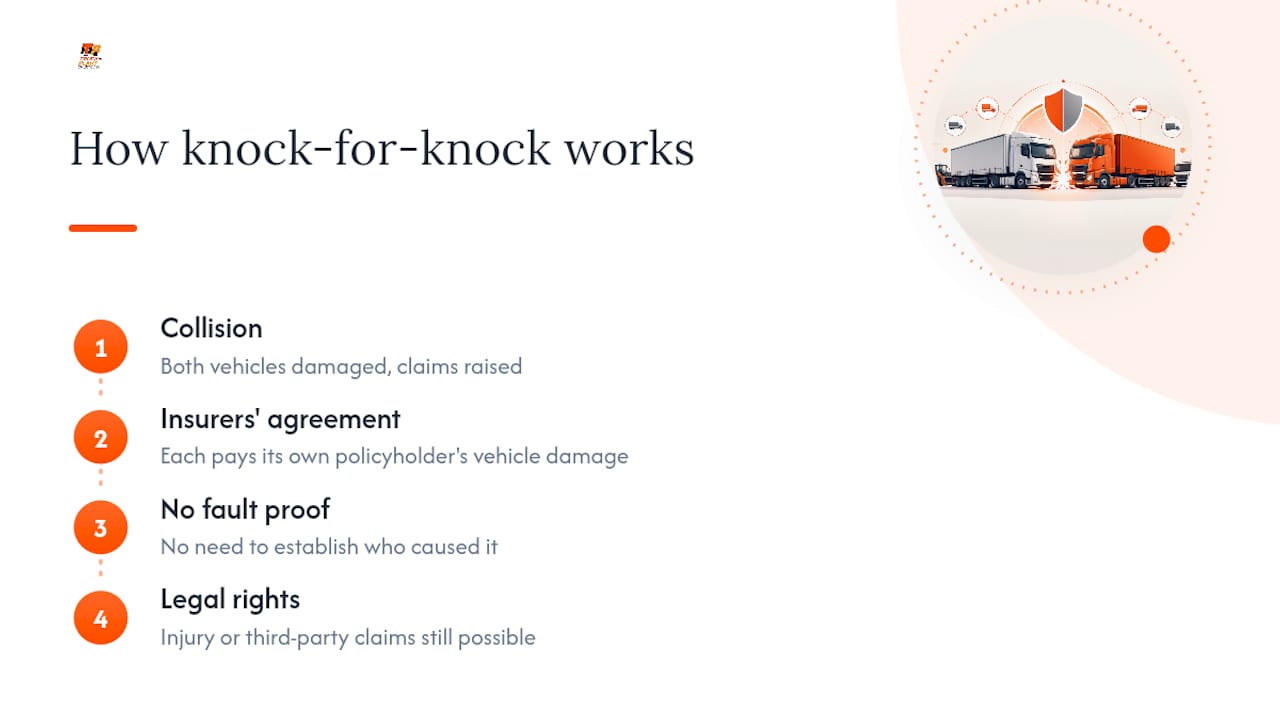
A knock-for-knock agreement is a private arrangement between insurers: each one settles its own policyholder’s vehicle damage, no matter who caused the collision. Nobody has to prove fault before repairs start.
The term didn’t originate in motor insurance. It comes from large industrial contracts, oil and gas projects especially, where multiple parties work on the same site and untangling blame after an incident would take years and cost more than the damage itself. Contract lawyers still use the same logic today, deciding upfront that loss lies where it falls rather than litigating every incident.
Insurers borrowed the idea for cars because it’s cheaper for them, too. Investigating fault, negotiating with another insurer, and possibly heading to court all cost money and time. Knock-for-knock skips that. It’s worth being clear, though, about what it settles and what it doesn’t: it resolves the insurers’ own-damage payout between themselves. It has no bearing on your legal right to claim for injury, or on a third party’s right to sue you directly if the damage is severe enough.
How a knock-for-knock claim actually plays out
Not every accident qualifies. Insurers check three things before applying the agreement: both vehicles need comprehensive cover, both insurers must be signatories to a knock-for-knock arrangement, and the incident needs to be a straightforward two-vehicle case rather than a multi-car pileup or a hit-and-run.
Assuming those boxes are ticked, the process is fairly linear:
- You report the accident to your own insurer, giving the other driver’s details and insurer name.
- Your insurer assesses the damage to your vehicle without waiting to establish fault.
- Your insurer pays for your own repairs, and the other driver’s insurer does the same for their side.
- Repairs proceed, often within days rather than weeks.
There’s a quiet exception worth knowing about. Insurers occasionally step outside the knock-for-knock arrangement and pursue third party recovery when the damage is large, when one driver was clearly reckless, or when a specific policy clause overrides the agreement. In those cases, your insurer may still chase the at-fault party’s insurer behind the scenes, even though your repair went ahead on the fast track.
Benefits and drawbacks of knock-for-knock cover
Speed is the headline benefit, but it’s not the only one. Weigh both sides before you assume knock-for-knock is automatically good news.
Benefits:
- Repairs start almost immediately since fault doesn’t need to be proven first.
- Fewer disputes between insurers means fewer delays for you.
- Lower administrative and legal costs for insurers, which helps keep premiums more stable industry-wide.
Drawbacks:
- The claim is still recorded against your policy, even when you weren’t at fault.
- Your no-claim bonus can take a hit, and your renewal premium may rise.
- It can feel unjust: you did nothing wrong, yet you carry a consequence anyway.
Pro Tip: Before you accept a knock-for-knock settlement, ask your insurer directly whether the claim will count against your no-claim bonus. Some insurers apply NCB protection differently depending on fault evidence, and it costs nothing to ask before repairs begin.
Industry commentary frames this trade-off plainly: certainty for insurers often comes at the expense of fairness for the innocent driver.
The effect on your no-claim bonus and future premiums
Here’s the part that catches drivers off guard. Your insurer records the payout as a claim on your policy, not as a fault determination. That distinction is what erodes your no-claim bonus even when the other driver caused the crash.
At renewal, most insurers apply a straightforward rule: a recorded claim, regardless of fault, moves you down the NCB scale unless your policy carries specific fault-based protection. That can mean a smaller discount and a higher premium the following year, even though you paid nothing out of pocket for repairs.
Three things limit the damage:
- Check your policy wording for how it defines a “claim” for NCB purposes.
- Ask whether NCB protection or a “fault claim exemption” is available as an add-on.
- Keep photos, witness details, and any dashcam footage in case you decide to pursue recovery instead.
When knock-for-knock applies, and where it doesn’t
Eligibility hinges on three conditions holding at once: both vehicles carry comprehensive, own-damage cover; both insurers are part of the knock-for-knock arrangement; and the incident is a clean two-party collision.
Several situations pull a claim outside the agreement:
- One driver is uninsured, or their policy has lapsed.
- The accident involves more than two vehicles, complicating loss allocation.
- Personal injury is involved, since knock-for-knock only ever covers vehicle damage.
- Environmental damage or third-party property loss falls outside the scope entirely.
Before assuming the agreement applies, check the policy sections on subrogation rights, your insured declared value (IDV), and your deductible. These clauses decide whether your insurer can still recover costs from the other party later, and how much you’ll pay upfront regardless.
Alternatives: when third-party recovery makes more financial sense
Knock-for-knock isn’t compulsory, and it isn’t always the smarter route. If the damage is minor and repair speed matters more than money, take the fast settlement. If the damage is significant, fault is clear, and protecting your no-claim bonus matters more than a quick fix, pursuing a liability claim against the at-fault driver’s insurer can be worth the wait.
To pursue recovery instead:
- Gather photos, witness statements, and any camera footage at the scene.
- Notify your insurer in writing that you intend to pursue third-party recovery rather than accept a knock-for-knock settlement.
- Involve legal counsel if the other insurer disputes fault or delays.
Fleet operators face a sharper version of this calculation. A single owner-driver might absorb a small NCB hit without much pain. A fleet manager juggling downtime costs, aggregated claims history, and multiple vehicles needs a claims process built for volume, not one-off decisions. Logistics operators tracking broader fleet cost pressures will recognise how quickly small claims compound across a large vehicle count.
Fleet management notes on knock-for-knock exposure
Fleet operators feel the knock-for-knock trade-off differently than individual drivers, because the maths scales. One own-damage claim barely dents a single policy’s NCB. Ten similar claims across a fleet, all recorded the same way, can shift renewal pricing meaningfully.
This is where policy design matters more than most fleet managers realise. Annual, fixed cover gives you no flexibility to adjust for a vehicle that’s parked for a month or a piece of plant machinery sitting idle on a site. On-demand cover lets you scale coverage to actual usage, which reduces the number of vehicles exposed to unnecessary own-damage claims in the first place.
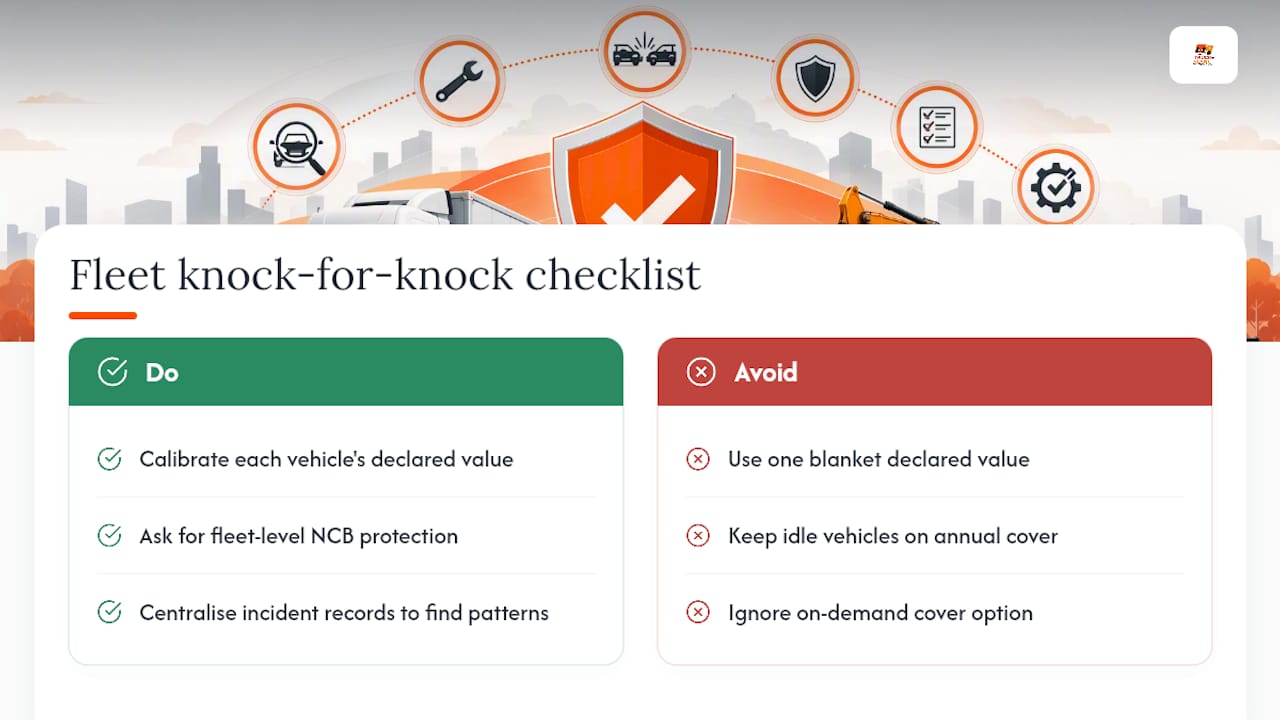
A practical checklist for fleet managers: calibrate your insured declared value per vehicle rather than applying one blanket figure, ask about NCB protection at the fleet level, and centralise incident records so patterns (a driver, a route, a vehicle type) surface before they become a renewal problem.
— Coert
Manage claim exposure with Truck & Plant On-Demand™
An alternative to locking your whole fleet into one annual policy that penalises you the same way whether a vehicle drives every day or sits idle for weeks. Adjustable, on-demand cover means you’re not paying, or claiming, on equipment you’re barely using, which could cut the number of small own-damage claims that quietly erode a fleet’s no-claim record.

With on-demand insurance, you can decide what’s covered and when, switching cover on and off as jobs, seasons, or fleet size change. That control matters most right after an accident, when the choice between a fast knock-for-knock settlement and a slower recovery claim depends on how much you actually have riding on your NCB that year. Compare your current annual cover against on-demand pricing and request a tailored quote through the Fleet Insurance page to see where the numbers land for your operation.
Sources
The Wikipedia entry on knock-for-knock agreements covers the core definition and rationale. IOL Business Report documents the NCB and premium consequences for South African policyholders. The academic paper on maritime risk allocation explains the industrial origins, and Bracewell LLP’s commentary details contract drafting exceptions.
This article is general information, not a substitute for advice from a qualified financial advisor. Consult a qualified financial professional about your own circumstances before acting on anything here.
- Knock-for-knock agreement
- Now you don’t have to take the knock
- Knock-for-knock risk allocation (academic article)