


Per-hour equipment insurance charges you only for the time your machinery is actually being used, replacing a fixed annual premium with a flexible, activity-triggered one. It suits rental operators, seasonal contractors, and anyone hiring equipment intermittently rather than running it year-round. For businesses with genuine idle periods, it can cut wasted premium significantly. Truck & Plant On-Demand™ is one route into this model, letting you switch cover on and off as your fleet’s activity changes.
TL;DR:
- Equipment used infrequently or seasonally benefits most from on-demand hourly insurance, which accurately charges only for periods of actual use.
- Accurate activation relies on digital platforms, approval of scheduled assets, and matching coverage certificates to specific hire periods to prevent gaps or disputes.
- The overall cost depends on equipment value, loss history, and exposure, with heavy machinery costing roughly 1% to 3% of its insured value annually, scaled down for hourly rates.
- On-demand insurance is best suited for businesses with low-utilization fleets or those renting equipment for short jobs, whereas continuous coverage suits high-usage assets.
- Combining hourly coverage with other policies such as inland marine, liability, and auto creates a comprehensive insurance stack that covers both equipment and operational risks.
Table of Contents
- How does per-hour equipment insurance actually work?
- Who benefits from hourly equipment insurance, and who shouldn’t bother?
- Which policies belong in a rental or hire insurance stack?
- What drives per-hour insurance pricing, and what should you expect to pay?
- How do you buy and set up per-hour coverage without gaps?
- What mistakes create the most claims disputes?
- How Truck & Plant On-Demand™ fits this checklist
- Is usage-based equipment cover a passing trend or a real shift?
- Get a quote for flexible equipment cover
- Sources
- FAQ
How does per-hour equipment insurance actually work?
Traditional equipment policies run on an annual cycle regardless of how often the machine leaves the yard. Usage-based cover flips that. You activate a policy when a piece of equipment starts a job and switch it off when the job ends, with premium calculated against actual hours or days of use rather than a flat twelve-month rate.
Activation is usually digital. You log into a platform or app, select the asset, confirm the hire or job window, and cover starts immediately. Some insurers tie activation to booking records from rental management software, which removes manual paperwork and creates a timestamped audit trail if a claim ever needs proving.
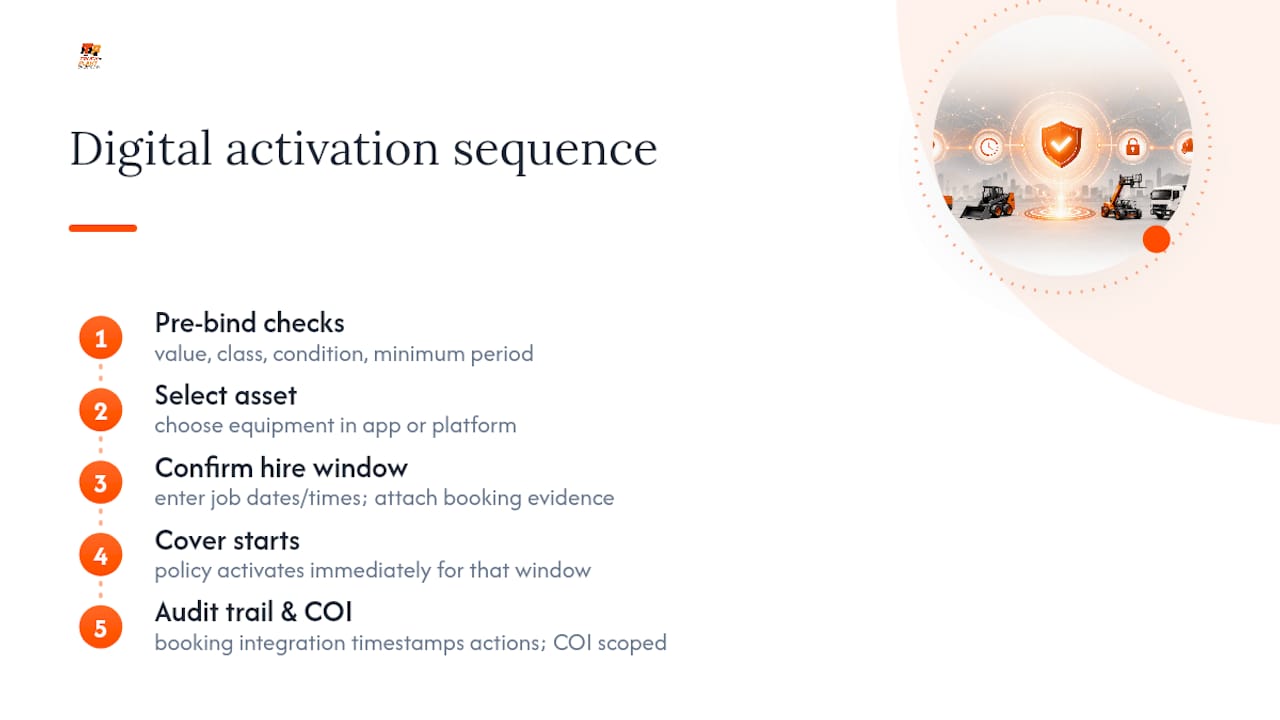
Insurers underwriting short-term cover still need baseline information before binding a policy: the equipment’s value, class, and condition, a minimum activation period (often a few hours or a full day, since insurers rarely price genuinely tiny increments), and some evidence of the booking or job, such as a rental agreement or purchase order.
Certificates of insurance work differently here too. Instead of one annual COI covering a fleet for twelve months, an on-demand insurer issues a certificate scoped to the exact hire window, naming the equipment owner as additional insured and loss payee for that period only. This matters when you are hiring machinery to a client for three days rather than three months. A rental machinery insurance guide covering endorsement wording is worth reviewing before your first short-term hire, since the additional insured language needs to match what the equipment owner’s contract requires.
Who benefits from hourly equipment insurance, and who shouldn’t bother?
Hourly cover rewards businesses whose equipment sits idle more than it works.
The clearest fits:
- Low-utilisation fleets — backup machines, specialty attachments, or equipment kept for occasional large jobs.
- Seasonal operators — landscaping, agriculture, or construction businesses with sharp activity spikes and long off-seasons.
- Occasional hirers — subcontractors who rent equipment for single jobs rather than owning it outright.
Annual scheduled coverage still wins in other situations. If equipment runs continuously, hourly billing adds administrative overhead without saving money. Lenders and general contractors also frequently demand proof of continuous annual coverage as a loan or subcontract condition, and a start/stop policy can create gaps that fail that requirement. A concrete example: a plant-hire company with three excavators running daily on a single site is usually better served by annual scheduled cover, while the same company’s spare compact loader, used four days a month, is a strong candidate for hourly billing.
Which policies belong in a rental or hire insurance stack?
Hourly cover for a single asset only solves part of the exposure. Rental and hire operations carry liability well beyond the machine itself, and a proper stack usually includes several distinct policies working together.
- Inland marine / equipment floater — the core cover for equipment while it’s off-premises, on a jobsite, in transit, or sitting in a storage yard. This is separate from standard commercial property insurance and is the policy type most commonly billed on a scheduled or blanket basis.
- General liability — protects against third-party injury or property damage claims arising from equipment use. Rental agreements typically require $1 million per occurrence, with the equipment owner named as additional insured.
- Commercial auto — covers trucks and trailers used to deliver or collect hired equipment, which a standard equipment floater does not touch.
- Loss-of-rents / business interruption — replaces income when a machine that would otherwise be earning rental revenue is out of service after damage or theft.
- Workers’ compensation and umbrella liability — necessary once you employ operators or drivers, with umbrella cover stepping in once payroll and exposure grow past the limits of your primary policies.
Whether you schedule individual items or carry a blanket limit changes the economics. High-value machines, excavators, cranes, compact loaders, are usually scheduled individually with agreed values, since a blanket policy’s per-item sublimit often falls well short of true replacement cost on a single large loss. Small tools and low-value attachments are better grouped under a blanket limit, avoiding the administrative cost of scheduling dozens of low-risk items. Truckplant’s own breakdown of essential construction insurance covers walks through how these policies interact on a working jobsite.
What drives per-hour insurance pricing, and what should you expect to pay?
Underwriters price equipment cover on a handful of variables that apply whether you’re buying annual or hourly cover: the equipment’s replacement cost versus its actual cash value, the deductible you select, the equipment’s class and total value, your loss history, and how exposed the asset is to theft or vandalism.
Pricing signal: Heavy equipment insurance typically runs 1% to 3% of total insured value annually, and choosing replacement cost coverage over actual cash value usually adds 10% to 20% to the premium. That gap buys you protection against depreciation shortfalls when a claim settles, which matters if a five-year-old machine gets written off and ACV pays out well below what a replacement actually costs.
Hourly and on-demand pricing structure this same underwriting logic differently. Rather than one annual figure, you get a per-hour or per-day rate, often with a minimum activation period and sometimes a cap once cumulative hours in a period reach a threshold that approaches annual-equivalent pricing.
To compare an hourly quote against a traditional annual policy, work backward from sample per-item annual ranges. Sector guides put mid-size equipment somewhere between $400 and $1,500 annually, and heavy machines higher, often $800 to $3,500 or more per scheduled item. Divide that annual figure by your expected hours of actual use to get a rough per-hour benchmark, then compare it against the on-demand quote. If a compact loader used 300 hours a year carries a $900 annual premium, that’s roughly $3 an hour, useful math when an on-demand insurer quotes you a per-hour rate and you want to know whether it’s genuinely cheaper for your usage pattern. Small operations stacking general liability and an equipment floater together often land somewhere between $1,100 and $3,000 a year in comparable markets, a useful budgeting anchor even before commercial auto or workers’ comp are added.
How do you buy and set up per-hour coverage without gaps?
Getting hourly cover right takes more upfront discipline than renewing an annual policy, because there’s no single binder covering you for the full year by default.
- Scope your inventory first. Decide which assets get individually scheduled with agreed values, and which small tools sit under a blanket limit.
- Ask the insurer the operational questions before binding. How does activation actually work, is there a minimum billing period, how is loss payee and additional insured wording handled, and what happens if you need to cancel or shorten a hire mid job?
- Prepare your documentation in advance. You’ll need a signed rental agreement, a COI template with the correct additional insured language, maintenance logs, and serial numbers for every scheduled item.
- Test the activation flow before you need it live. Activate a dummy or low-value hire, confirm a certificate of insurance generates correctly and reaches the right party, and check the dates match the actual hire window.
Getting this workflow tight before your first real hire saves a scramble later when a client needs proof of cover within the hour. Truckplant’s guide on tool hire business insurance types is a useful companion here, since it walks through exactly how scheduled and blanket limits interact with per-item values.
What mistakes create the most claims disputes?
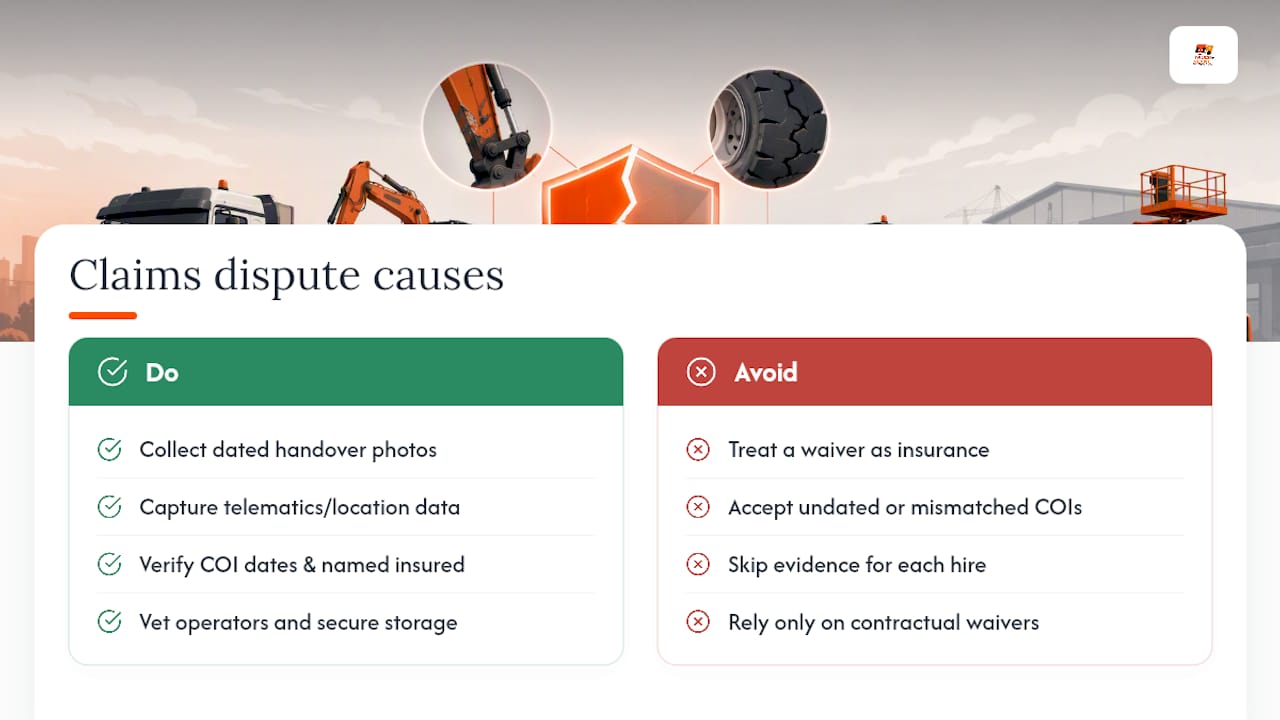
Most denied or disputed claims in rental operations fail on evidence, not on coverage gaps. An insurer rarely refuses a legitimate claim outright; they refuse one they can’t verify.
Damage waivers are the most common source of false confidence. A waiver sold alongside a rental agreement is a contractual risk transfer, not an insurance policy, and it typically carries carve-outs for theft, gross negligence, or damage outside normal use. Treating a waiver as a substitute for real physical-damage coverage leaves a real gap.
Undated or mismatched certificates of insurance are the second big trap. A COI that doesn’t cover the exact hire dates, or that misnames the additional insured, gives an insurer legitimate grounds to deny a claim tied to that period.
Pro Tip: Pair every hire with dated handover photos and, where possible, telematics data. Insurers increasingly treat documented tracking as evidence that reduces claims friction, and some offer underwriting credit for fleets that can prove asset location and usage history.
Vetting who operates the machine and confirming secured storage between hires rounds out the basic controls that keep a policy, not a waiver, doing the real work.
How Truck & Plant On-Demand™ fits this checklist
Every item in the checklist above maps directly onto how on-demand insurance platforms are built to operate. Cover activates digitally against a specific hire or job window, which means the certificate of insurance an operator issues to a client is scoped to the actual dates of use, not a generic annual document that needs manual editing every time.
Because the model is pay-per-use, a business with a low-utilisation fleet, that spare compact loader used four days a month, isn’t stuck funding a full annual premium to keep one asset legally covered. Limits and endorsements can flex as jobs come and go, which is precisely the flexibility a rental operator or subcontractor needs when hire volume swings between quiet months and peak season. The digital activation model also integrates with rental booking software, cutting the manual admin that usually accompanies short-term certificate requests.
Is usage-based equipment cover a passing trend or a real shift?
Usage-based insurance is scaling for hire fleets because it matches a real operational pattern: idle equipment shouldn’t cost the same to insure as equipment working full time. That logic isn’t new to insurance generally, motor insurers have offered pay-as-you-drive products for years, but equipment and plant cover has been slower to catch up.
The friction points worth watching are contractual, not technical. Lenders and main contractors still often specify continuous annual coverage in finance agreements or subcontracts, and an hourly policy needs to satisfy those clauses explicitly rather than assuming flexibility will be welcomed. Telematics standards are also still fragmented across equipment brands, which limits how consistently insurers can price usage credits fleet-wide.
My honest read: if your utilisation sits meaningfully below continuous use, hourly cover is worth quoting now rather than waiting for the market to mature further.
— Coert
Get a quote for flexible equipment cover
If the checklist above sounds like your fleet, idle days between hires, seasonal spikes, subcontractors who need a certificate scoped to a single job, on-demand insurance is built for exactly that pattern rather than forcing you into a fixed annual premium regardless of how often your machines actually work.

You stay in control of what’s covered and when, adjusting cover as jobs start and stop instead of paying for idle equipment twelve months a year. If you run a mixed fleet of trucks, trailers, and plant machinery, the fleet insurance page for commercial vehicle and plant operators walks through how the on-demand model applies across vehicle and equipment categories together. Request a quote there to see what your actual usage pattern would cost against a traditional annual policy, and whether switching genuinely nets you the savings this article’s math suggests.
Sources
For deeper detail on cost ranges and policy structure, the construction equipment insurance cost guide and the heavy equipment insurance guide for contractors both break down premium drivers in more depth. Rental operators specifically should also review what rental insurance actually needs to cover and the operator-focused equipment rental insurance guide on claims evidence and damage waivers. If your equipment regularly moves between sites, the partner guide on moving insurance and protecting transported items is a useful companion on transit risk.
- Construction Equipment Insurance: Cost & Coverage Guide
- Heavy equipment insurance: contractors’ guide
- Equipment rental insurance: what you actually need
FAQ
What kind of insurance do I need for equipment?
At minimum, you need an inland marine or equipment floater for physical damage while the asset is off-premises, plus general liability for third-party claims. Rental operators typically add commercial auto, workers’ comp, and umbrella cover once payroll and delivery vehicles are involved.
What is covered under equipment insurance?
A standard equipment floater covers physical loss or damage from theft, vandalism, fire, and accidental damage while the machine is on a jobsite, in transit, or in storage. It does not cover normal wear and tear or damage explicitly excluded by policy wording, so reviewing exclusions before a hire matters.
Is per hour equipment insurance worth it for a small hire business?
It’s worth it when your equipment sits idle more than it works, since you avoid paying full annual premium for months of non-use. If your fleet runs near-continuously, an annual scheduled policy is usually the cheaper and simpler option.
Can you insure your salary?
That’s a different product entirely, known as income protection insurance, and it’s unrelated to equipment coverage. It pays a portion of your income if illness or injury stops you working, rather than covering machinery or liability.
How long can income protection cover pay you for?
Payout duration depends entirely on the specific policy terms, ranging from a couple of years to cover until retirement age on some plans. Check the benefit period stated in your policy document rather than assuming a standard duration applies.