


TL;DR:
- On-demand insurance activates coverage only during operational periods, reducing costs for seasonal and project-based fleets. It relies on telematics data, allowing pay-per-mile, behavior-based, or hourly billing models to match actual usage. This approach offers significant savings and operational insights but requires careful testing, data management, and understanding of exclusions.
On-demand commercial insurance, also called seasonal or usage-based insurance (UBI), lets fleet operators and plant hire businesses activate liability and physical-damage cover only when assets are working, paying for actual exposure rather than a fixed annual premium. It suits seasonal contractors, project-based plant hire, and tool rental operations with significant idle time. The core tradeoff: lower wasted premium in exchange for telematics data sharing and more active policy administration.
Table of Contents
- What seasonal (on-demand) insurance actually is
- Cover lines you can expect under an on-demand program
- How on-demand cover works in practice
- Why operators choose on-demand cover
- Drawbacks, exclusions, and U.S. regulatory traps
- When on-demand cover is the right choice
- How to evaluate and pilot on-demand cover
- What drives your on-demand premium
- Activation timelines, recordkeeping, and audit readiness
- Key takeaways
- The case for treating insurance as an operational variable
- How Truckplant supports on-demand cover for U.S. fleets
- Useful sources and further reading
What seasonal (on-demand) insurance actually is
Standard commercial fleet policies price cover on estimated annual mileage and asset count, then bill a fixed premium regardless of how much equipment actually moves. On-demand, usage-based insurance flips that model. Cover activates when you need it, deactivates when you don’t, and pricing ties directly to measured exposure.
Three billing models dominate the market. Pay-as-you-drive (PAYD) charges a per-mile rate, typically $0.08–$0.18 for commercial auto. Pay-how-you-drive (PHYD) weights price on driving behavior scores: speed, braking, cornering. Pay-as-you-go (PAYG) blends both, using hours of operation or job-site time as the primary trigger. For a deeper look at how these compare with fixed-term policies, annual vs. on-demand vehicle insurance is worth reading before you talk to a broker.
Cover lines you can expect under an on-demand program
Most on-demand commercial programs offer the following:
- Commercial auto liability: bodily injury and property damage to third parties while a vehicle is in operation.
- Physical damage: collision and comprehensive cover for your own vehicles and plant, active only during authorized periods.
- Inland marine: tools, attachments, and equipment in transit or temporarily off-site.
- Equipment breakdown: covers sudden internal mechanical or electrical failure, including motor burnout and short circuits, plus associated business income loss.
- Environmental/third-party liability: pollutant liability for specific job types such as fuel hauling or chemical transport.
- Group personal accident: injury cover for operators and crew during active work periods.
Add-ons commonly available include hired/non-owned auto, rental reimbursement, and enhanced pollutant liability for high-risk routes.
Pro Tip: Equipment breakdown and inland marine are not interchangeable. Inland marine covers physical loss or damage in transit; equipment breakdown covers internal failure while the machine is stationary and operating. Confirm both are in your program if you run high-value plant.
How on-demand cover works in practice
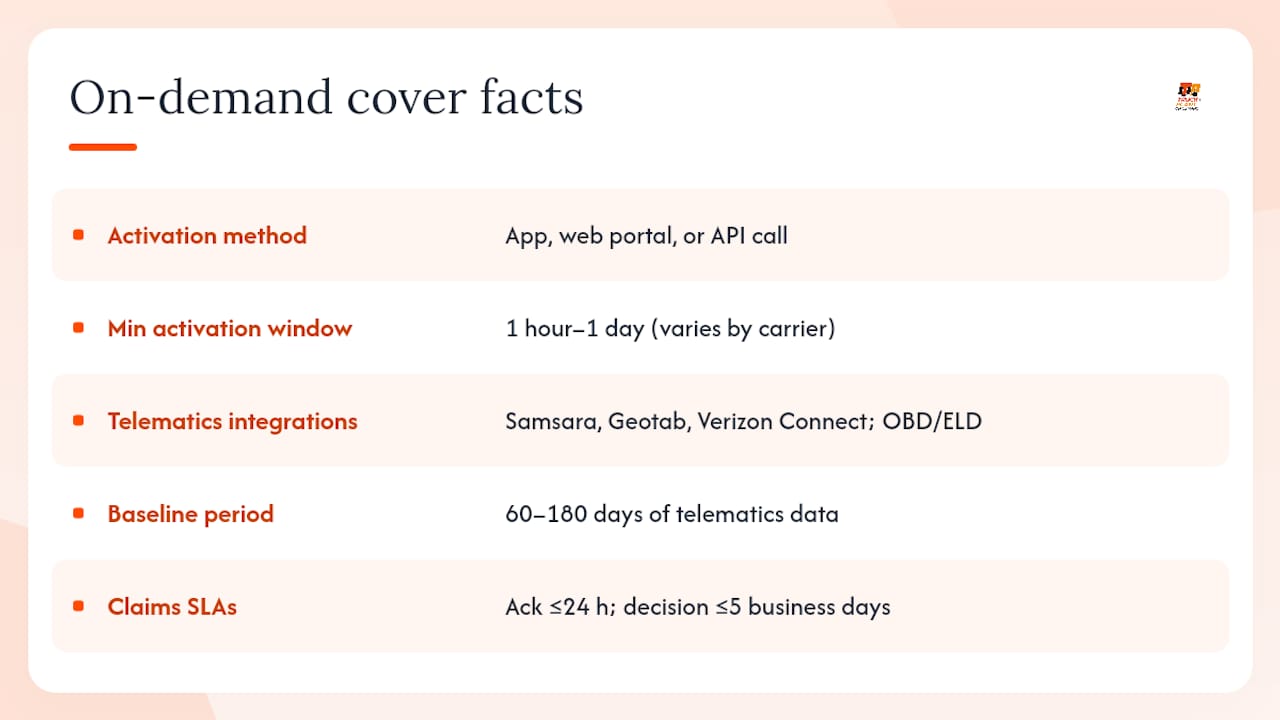
Activation typically happens through a mobile app, a web portal, or an API call from your existing fleet management system. Most programs require a minimum activation window of one hour to one day, depending on the carrier and asset class.
Telematics data feeds pricing in real time. Modern programs support direct API integrations with platforms such as Samsara, Geotab, and Verizon Connect, so you often don’t need additional hardware. OBD devices and ELD data are also accepted by many carriers.
Carriers typically collect baseline telematics data for 60–180 days before applying a fully adjusted rate. Expect your initial premium to reflect estimated exposure, with a telematics-derived adjustment at first renewal rather than at binding.
Claims follow a digital intake path: you submit via app or portal, attach telematics exports and photos, and the carrier cross-references the activation log to confirm the asset was covered at the time of the incident. Response SLAs vary, but leading programs target an initial acknowledgment within 24 hours and a coverage decision within five business days for straightforward claims.
Pro Tip: Before your first activation, run a test claim submission in your provider’s portal. Confirm that your telematics export format is accepted and that activation timestamps are recorded in UTC or a consistent time zone. Discrepancies here are the most common cause of claims delays.
Why operators choose on-demand cover
The financial case is direct. PAYD programs offer notable savings for lower-mileage or seasonal operators, and combined UBI programs can reach substantial discounts in favorable conditions. For plant hire businesses with equipment sitting idle for months at a time, that gap between what you pay and what you actually need is exactly what on-demand cover eliminates.
- Reduced wasted premium: pay only for active exposure, not for assets parked in your yard.
- Project accounting clarity: match insurance cost to job revenue, making project P&L more accurate.
- Scalability for rentals: activate cover per rental event without restructuring your annual policy.
- Telematics-driven premium credits: carriers including Munich Re have documented rebates near 15% for telematics-enabled coaching programs, with commercial program credits commonly cited in the 10–25% range.
- Proactive loss control: real-time driver feedback reduces claims frequency and severity, turning your insurance data into a safety management tool.
For construction fleets specifically, the advantages of dynamic insurance extend beyond premium savings to simpler certificate issuance for short subcontract engagements.
Drawbacks, exclusions, and U.S. regulatory traps
On-demand cover is not a fit for every operation. Know these limits before you commit:
- Exclusions to watch: pre-existing mechanical wear is not covered under equipment breakdown wording; full replacement value gaps may exist if your physical damage limit is based on book value rather than agreed value.
- Environmental liability limits: standard pollutant liability add-ons often exclude gradual contamination; sudden and accidental events only.
- State minimum liability filings: each state sets its own minimum commercial auto liability limits, and carriers must file rates with state regulators. Multi-state operations need to confirm that the program covers all operating territories.
- Workers’ compensation is separate: on-demand vehicle cover does not replace workers’ comp, which remains a mandatory, separately purchased line in every U.S. state.
- Data privacy: telematics data collected by carriers is subject to state privacy laws; confirm data ownership and retention terms in writing.
- Mid-term surcharges: poor telematics scores during the data collection window can trigger a mid-term adjustment before renewal.
When on-demand cover is the right choice
Four scenarios consistently show the strongest return:
- Project-based plant hire: equipment is on-site for a defined period, then returned. Activating cover only for that window eliminates idle-period premium entirely.
- Seasonal contractors: snow-removal crews, irrigation installers, and summer roadworks contractors run hard for three to five months and park for the rest. A fixed annual policy charges for all twelve.
- Tool rental businesses: per-rental activation aligns insurance cost to rental revenue, and optimizing equipment usage between rentals reduces both idle time and idle premium.
- Short-term subcontractor engagements: adding a vehicle to an annual fleet policy for a six-week subcontract is administratively inefficient and often over-insures the exposure.
How to evaluate and pilot on-demand cover
Follow this sequence before committing:
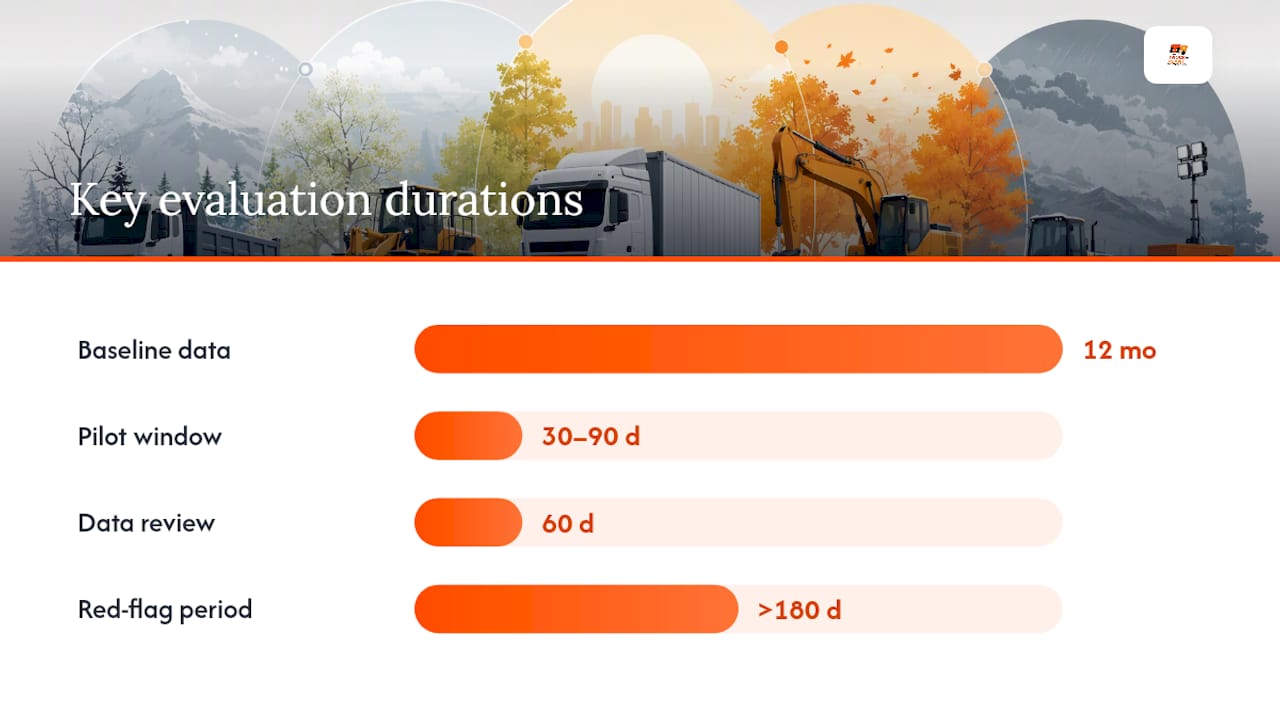
- Gather utilization data. Pull 12 months of mileage, hours, and idle-period records for every asset you plan to cover.
- Map assets to cover lines. Identify which vehicles need PAYD, which plant needs PAYG, and which tools need inland marine or equipment breakdown.
- Test API or telematics integration. Confirm your fleet system (Samsara, Geotab, or equivalent) can push data to the carrier’s platform before you bind.
- Run a 30–90 day parallel pilot. Keep your existing policy active and run the on-demand program alongside it for one asset class. Compare actual premium against the baseline.
- Measure the right metrics: premium saved vs. baseline, number of activations, claims frequency, and administrative time per activation.
Questions to ask every provider:
- What is the minimum activation window, and how is it billed?
- Who owns the telematics data, and how long is it retained?
- What is your claims SLA for commercial fleet incidents?
- How long is the baseline data collection period before adjusted rates apply?
Red flags: programs that require a proprietary telematics device incompatible with your existing fleet system, or that apply a data-harvest-only period longer than 180 days before any discount is visible.
Pro Tip: Run a 60-day parallel data review before requesting a formal quote. Carriers that see clean, consistent telematics data from day one offer better initial rates than those estimating from scratch.
What drives your on-demand premium
| Pricing model | Best fit | Typical savings range | Main requirement |
|---|---|---|---|
| PAYD (pay-per-mile) | Low-mileage, seasonal, idle-heavy fleets | Significant savings compared with fixed annual pricing for such fleets | Accurate mileage reporting via telematics or ELD |
| PHYD (pay-how-you-drive) | Fleets with variable driver behavior | Average savings around 22% | Continuous behavior scoring (speed, braking, cornering) |
| PAYG (hybrid) | Plant hire, project-based, hourly assets | up to 25% savings | Hours-of-operation data or job-site activation logs |
Beyond the billing model, carriers weight: asset value and weight class, territory and route risk, driver history and claims record, and the quality of your telematics data feed. Fleet programs covering 10 or more vehicles can access scheduled rating that reduces per-unit costs by roughly 10–20% compared with individually written policies.
Activation timelines, recordkeeping, and audit readiness
| Step | Typical window | Notes |
|---|---|---|
| Policy activation | Immediate to 1 hour | App or portal; API calls can be near-instant |
| Minimum cover period | 1 hour to 1 day | Varies by carrier and asset class |
| Billing cycle | Daily, weekly, or monthly | Confirm cadence before binding |
| Telematics data collection | 60–180 days | Rate adjustment typically applies at first renewal |
| Claims evidence window | 30–90 days post-incident | Telematics exports, activation logs, photos |
Recordkeeping checklist for audit readiness:
- Activation and deactivation logs with timestamps for every asset.
- Rental or job sheets that match activation periods.
- Telematics exports archived by asset and date.
- Certificates of insurance issued for each active period.
- Claims documentation including photos, driver statements, and telematics data.
Carriers verify usage periods against telematics timestamps. Gaps between activation logs and telematics records are the most common audit failure point.
Key takeaways
On-demand, usage-based commercial insurance is the most cost-efficient cover structure for fleets and plant hire businesses with significant idle time or project-based operations.
| Point | Details |
|---|---|
| Pay for actual exposure | PAYD programs average savings near 30% for seasonal or low-mileage operators versus fixed annual premiums. |
| Equipment breakdown is separate | Inland marine covers transit loss; equipment breakdown covers internal mechanical failure and business income loss. |
| Telematics data quality matters | Noisy or incomplete data can trigger mid-term surcharges; clean feeds unlock the best rates and credits. |
| Run a pilot before full migration | A 30–90 day parallel pilot with utilization data gives you a defensible savings projection before committing. |
| Truckplant | Truck & Plant On-Demand™ supports real-time activation, API integrations, and the full cover lines described above for commercial vehicles and plant, including equipment breakdown coverage for sudden internal mechanical or electrical failure and associated business income loss. |
The case for treating insurance as an operational variable
Most fleet operators I speak with still treat insurance as a fixed overhead, something to renew annually and file away. That framing costs money. The operators who get the most from on-demand cover are the ones who integrate activation into their dispatch workflow, not their finance calendar.
The real shift is not just financial. When telematics data flows from your fleet system into your insurance program, you gain a feedback loop that most safety managers pay separately for: real-time coaching data, driver behavior scores, and incident patterns tied to specific routes or assets. That data has value beyond the premium discount. It tells you where your next claim is likely to come from before it happens.
The conventional wisdom says on-demand cover is for small operators who can’t afford annual premiums. That’s wrong. The strongest adopters are mid-size fleets and plant hire businesses with 15–50 assets, enough operational complexity to benefit from per-asset activation control, and enough utilization data to negotiate from a position of strength. If you’re in that range and still on a fixed annual policy, you’re subsidizing operators who use their assets more than you do.
How Truckplant supports on-demand cover for U.S. fleets
Paying a fixed annual premium for assets that sit idle half the year is a straightforward cost problem with a straightforward solution. Truckplant’s Truck & Plant On-Demand™ lets you activate cover per asset, per job, or per rental period, with full control over what you insure, when, and at what level. The program covers commercial vehicles, trucks, trailers, and yellow plant machinery, with add-ons for equipment breakdown, environmental liability, and group personal accident.
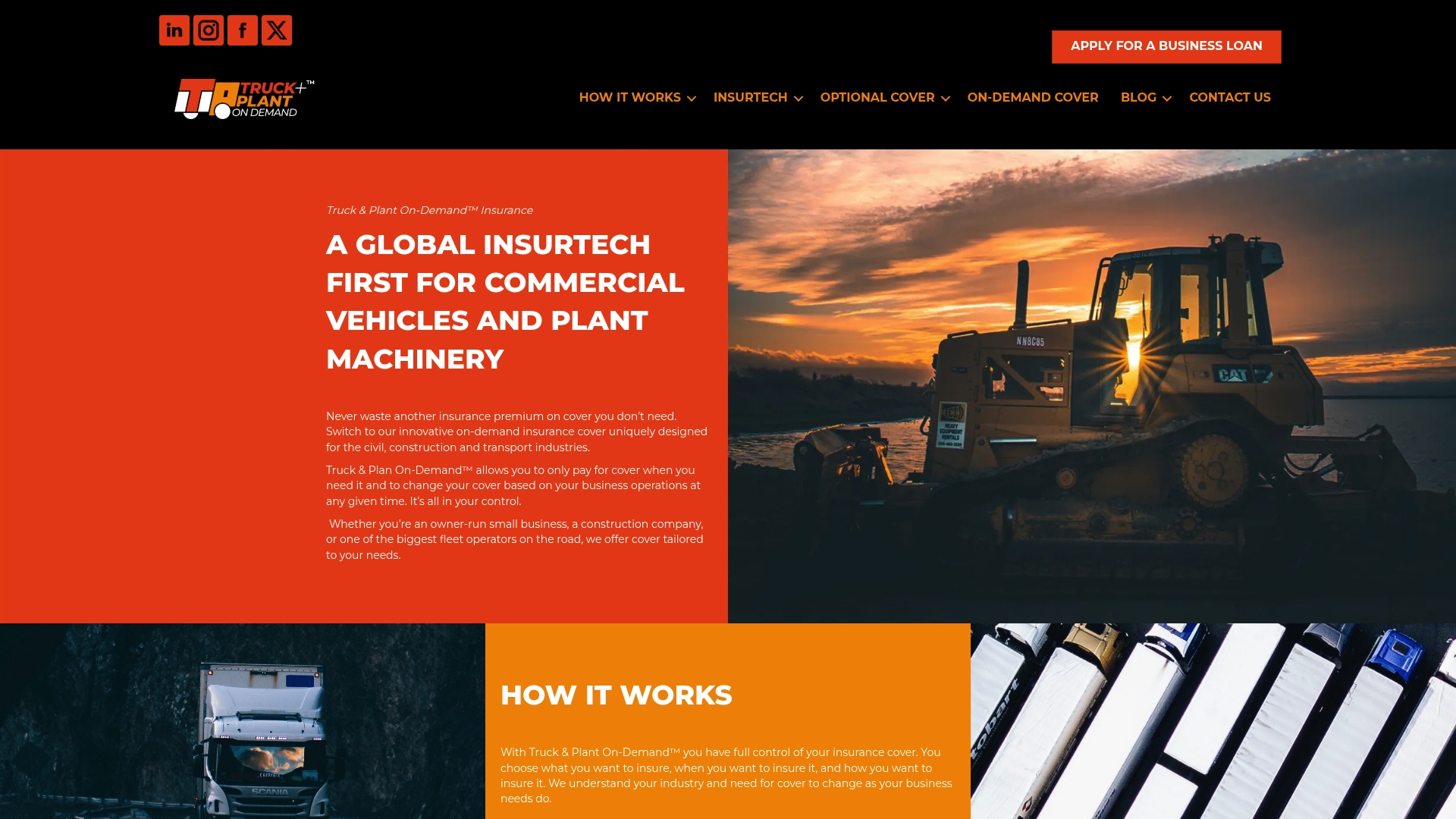
Integration with existing fleet management systems means you’re not adding hardware or rebuilding workflows. Cover adjusts as your operations do. To see how the program maps to your fleet’s specific exposure, request a pilot review and bring your last 12 months of utilization data. That’s the fastest way to build a credible savings projection.
Useful sources and further reading
- Usage-Based Insurance (UBI) and Telematics — Geotab
- Usage-Based Insurance Program — SambaSafety
- How ELD/Telemetry Engagement Impacts Trucking Premiums — Overdrive Online
- On-Demand Insurance for Construction and Transport — Truckplant
- Insurance Policy Types for Construction — Truckplant