


TL;DR:
- User-controlled insurance policies offer policyholders mid-term flexibility through endorsements and automated parametric triggers tailored to operational risks. endorsements require formal approval and involve structured processes, while parametric policies provide automatic payouts based on measurable triggers set at inception. Both approaches enable proactive risk management but demand precise planning and documentation to minimize gaps and optimize operational control.
User-controlled insurance policies are insurance arrangements that allow policyholders to adapt, modify, or trigger coverage during the active policy term, rather than locking in fixed terms at inception. In the construction, civil engineering, and transport sectors, this flexibility is not a luxury. It is a practical necessity. Projects change scope, weather disrupts schedules, fleets expand and contract, and liability requirements shift from contract to contract. The two primary mechanisms delivering this control are traditional policy endorsements and parametric insurance. Understanding both gives you the power to build cover that matches your actual operational risk at any given time, rather than paying for a one-size-fits-all policy that rarely fits at all.
What are user-controlled insurance policies and how do they work?

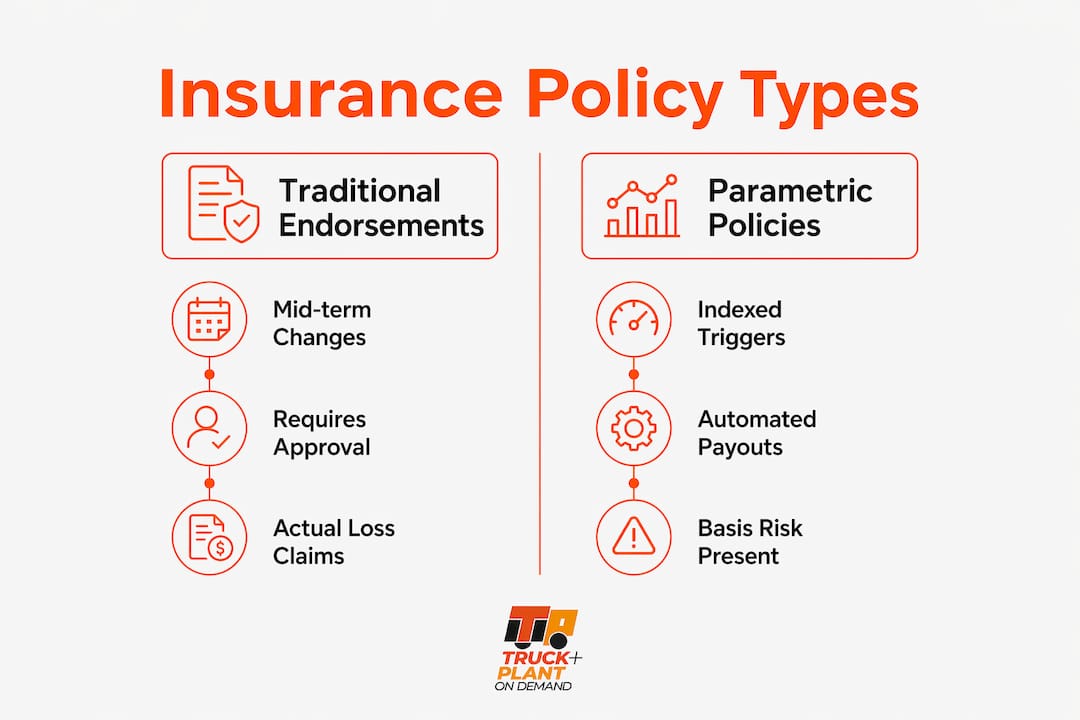
User-controlled insurance policies operate through two distinct channels. The first is the endorsement model, where you request mid-term changes to your existing policy through your broker, subject to carrier approval. The second is the parametric model, where you pre-define measurable triggers at policy inception and payouts occur automatically when those triggers are met. Both approaches give you more control than a standard fixed policy, but they work very differently in practice. Knowing which mechanism suits which operational scenario is the foundation of smart customizable policy coverage for your business.
How do traditional insurance endorsements enable user control?
Policy endorsements are the official mechanism for modifying an insurance contract mid-term. They add, remove, or change coverage terms, and they require carrier approval along with documented requests. This is not a unilateral change you make yourself. It is a structured process involving your broker, the insurer, and formal paperwork. When approved, the endorsement becomes part of your policy and, critically, the most recent endorsement takes precedence over the base policy language when conflicts arise.
For construction, civil engineering, and transport businesses, three endorsement types are particularly relevant:
| Endorsement type | Purpose | Typical premium impact |
|---|---|---|
| Additional insured | Extends your liability cover to a third party, such as a project owner or subcontractor | Moderate increase |
| Waiver of subrogation | Prevents your insurer from recovering costs from a named third party after a claim | Small to moderate increase |
| Primary and noncontributory | Makes your policy pay first before any other coverage the third party holds | Moderate increase |
Each of these is commonly required by contract in the construction and civil engineering sectors. Missing one on a live project creates a coverage gap that can expose your business to significant financial liability. The endorsement workflow matters as much as the endorsement itself. Proper procedures include submitting a documented request, verifying authority, matching the correct form to the policy, and confirming effective dates. Skipping any step risks errors that only surface at claims time.
Pro Tip: Conduct a full endorsement audit at every policy renewal. List every endorsement added during the term, confirm each one is still needed, and remove any that no longer apply. This prevents premium creep and eliminates outdated coverage obligations.
What is parametric insurance and how does it give you control?
Parametric insurance replaces the traditional claims assessment process with a predefined, automated payout structure. You choose the trigger conditions at inception, and when an independent data source confirms those conditions are met, the payout is released. There is no loss adjustment, no subjective damage assessment, and no lengthy claims negotiation. Payouts can arrive within two weeks of a trigger event, which protects your cash flow at exactly the moment your project is under pressure.
The customisation levers in a parametric policy are specific and practical:
- Peril selection: Choose the weather event that most threatens your operations, such as wind, rainfall, extreme heat, or frost.
- Index type: Define whether the trigger measures days or hours of exposure to the peril.
- Trigger threshold: Set the measurable point at which the payout activates, for example wind speeds exceeding a defined threshold confirmed by the National Weather Service or an equivalent authority.
- Payout amount: Fix the rand or dollar value released per trigger event, calibrated to your actual project cost exposure.
Contractors can control perils, indices, triggers, and payout amounts to build cover that reflects their specific project conditions. A road construction company in a summer rainfall region, for instance, would structure a very different parametric policy than a civil engineering firm working on a coastal bridge project exposed to wind risk. The trigger data comes from objective third-party sources, which eliminates disputes about whether a weather event actually occurred.
The trade-off is basis risk. Your actual financial loss may differ from the parametric payout, either above or below. If your trigger fires but your project suffered minimal disruption, you receive the payout regardless. If your project suffers significant loss but the trigger threshold was not quite met, you receive nothing. This is why precise trigger definitions are the most critical engineering decision in a parametric policy.
Pro Tip: Align your parametric trigger thresholds directly with the weather day allowances written into your project contracts. If your contract allows five rain days per month before penalties apply, set your parametric trigger to activate at day five. This creates a direct financial hedge against contractual exposure.
How do user-controlled policies compare to traditional fixed coverage?
The differences between fixed policies, endorsement-modified policies, and parametric policies are significant across four dimensions: control, speed, cost certainty, and administrative burden.
| Feature | Traditional fixed policy | Endorsement-modified policy | Parametric policy |
|---|---|---|---|
| Mid-term flexibility | None | High, with carrier approval | Pre-set at inception |
| Claims speed | Weeks to months | Weeks to months | Days to two weeks |
| Payout basis | Actual proven loss | Actual proven loss | Trigger event confirmed |
| Administrative burden | Low | Moderate to high | Low once structured |
| Suitability | Stable, predictable operations | Variable project requirements | Weather and event-driven risks |
User control in traditional insurance is exercised through broker-assisted endorsement negotiations, not through direct policy changes. This distinction matters because many business owners assume they can simply call their insurer and adjust cover on the spot. The reality is that every mid-term change requires a formal request, carrier review, and documented approval. Parametric policies shift this dynamic entirely. Once structured, they operate without ongoing administrative intervention. The algorithmic settlement process removes human subjectivity from the claims outcome, which is particularly valuable when you are managing multiple active projects simultaneously and cannot afford delays in cash flow.
For transport operators, the comparison is equally clear. A fleet running seasonal routes faces different risk profiles in summer versus winter. A fixed policy priced for peak exposure wastes premium during low-risk periods. Endorsement-based flexible insurance plans allow you to adjust liability limits, add or remove vehicles, and modify coverage terms as your operational footprint changes.
How to implement user-controlled cover in your business
Adopting flexible, user-directed insurance solutions requires a structured approach. The following steps apply whether you are pursuing endorsement-based flexibility or parametric cover.
-
Map your operational risk calendar. Identify the periods, projects, and conditions that create your highest exposure. For construction firms, this typically means wet season schedules, high-value equipment on site, and subcontractor liability requirements. For transport operators, it means peak freight periods, route-specific risks, and fleet size fluctuations.
-
Brief your broker with contract-level detail. Share your project contracts, subcontractor agreements, and client requirements. Your broker needs this information to identify which endorsements are contractually required and whether parametric triggers can be engineered to match your specific exposure windows.
-
Request a tailored endorsement schedule. Ask your broker to draft a schedule of all endorsements you are likely to need across the policy term. This prevents reactive, last-minute requests that slow down project starts and create coverage gaps.
-
Design parametric triggers around measurable project milestones. Work with a specialist broker or insurer to align trigger thresholds with your contractual weather day allowances, project completion dates, and cash flow requirements. Truckplant’s approach to tailored fleet cover demonstrates how this kind of operational alignment translates into practical cover design.
-
Build a mid-term review into your project management process. Schedule a policy review at the midpoint of every major project. Confirm that all endorsements are current, that parametric triggers still reflect actual conditions, and that your cover limits match the current value of work in progress.
-
Document everything. Every endorsement request, approval, and effective date must be recorded. At claims time, documentation is the difference between a paid claim and a disputed one.
The innovative insurance models now available to construction and transport businesses make this level of precision achievable. The key is treating your insurance programme as a live management tool, not an annual administrative task.
Key takeaways
User-controlled insurance policies deliver genuine operational value only when the control mechanisms, endorsements or parametric triggers, are precisely engineered to match your actual project and fleet risk profile.
| Point | Details |
|---|---|
| Endorsements require carrier approval | Mid-term policy changes are formal, documented processes, not instant adjustments. |
| Parametric payouts are trigger-based | Payouts arrive within two weeks but depend entirely on how well triggers are defined at inception. |
| Basis risk is the parametric trade-off | Your actual loss and your parametric payout may not match; precise trigger design minimises this gap. |
| Endorsement audits prevent premium creep | Review every endorsement at renewal to remove outdated obligations and control costs. |
| Flexible cover supports project competitiveness | Tailored cover lets you meet contract requirements faster and protect cash flow during disruptions. |
Why most businesses underestimate what “user control” actually means
I have worked with enough construction and transport operators to know that the phrase “user-controlled insurance” creates a specific expectation that the reality does not always match. Business owners hear “control” and picture a dashboard where they switch cover on and off like a light. What they get, in most cases, is a structured negotiation process with a carrier that takes days or weeks and requires documentation they did not know they needed.
This is not a criticism of the insurance industry. It is a reflection of how risk is actually managed. Carriers need to assess every mid-term change because every change affects their exposure. The businesses that get the most from flexible policies are the ones that plan their endorsement needs in advance, brief their brokers with contract-level specificity, and treat policy management as an ongoing operational function rather than a once-a-year event.
Parametric insurance is genuinely different in this respect. Once the trigger parameters are set, the policy runs itself. But the engineering work at inception is where most businesses underinvest. I have seen parametric policies structured with trigger thresholds that were too conservative, firing payouts on minor weather events, and others set too high, leaving businesses uncompensated after genuine disruptions. The quality of the trigger design determines the quality of the outcome. Get that right, and parametric cover is one of the most powerful risk management tools available to construction and transport businesses today.
— Coert
Flexible on-demand cover built for your industry
If you operate commercial vehicles, trucks, or plant machinery in the construction, civil engineering, or transport sectors, Truckplant’s Truck and Plant On-Demand™ is built specifically for your operational reality.
With Truck and Plant On-Demand™, you choose what to insure, when to insure it, and how to insure it. You pay only for the cover you need, when you need it. There are no fixed monthly premiums for cover that sits unused. Whether you run a single owner-operated truck or a large mixed fleet, Truckplant offers fleet insurance for commercial vehicles structured around your actual operations. You can also explore truck insurance options designed for the specific demands of South African road and project conditions. Cover that changes when your business does. That is the Truckplant standard.
FAQ
What are user-controlled insurance policies?
User-controlled insurance policies are arrangements that allow policyholders to modify coverage terms mid-term through endorsements or to trigger automated payouts through parametric structures. Control is exercised through formal broker-assisted processes, not unilateral changes.
How do endorsements differ from parametric insurance?
Endorsements modify existing policy terms with carrier approval and affect actual-loss claims. Parametric insurance pays out automatically when a predefined measurable trigger is confirmed by objective data, with no claims assessment required.
Can I change my insurance cover mid-project?
Yes, through a formal endorsement request submitted by your broker to the carrier. Endorsements require approval and may adjust your premium on a prorated basis for the remaining policy term.
What is basis risk in parametric insurance?
Basis risk is the difference between your actual financial loss and the parametric payout you receive. If your loss exceeds the payout, or the trigger is not met despite real disruption, the gap is your exposure. Precise trigger design at inception is the primary way to manage this risk.
Is parametric insurance suitable for transport fleets?
Parametric insurance is most effective for weather-driven risks with measurable triggers, making it well-suited to construction and civil engineering projects. Transport fleets with route-specific weather exposure can also benefit, particularly when trigger parameters are aligned with seasonal operational patterns.