


TL;DR:
- Most South African construction and transport businesses pay full premiums year-round for equipment that is periodically idle. On-demand machinery insurance allows operators to activate or suspend cover based on actual equipment use, offering significant cost and cash flow advantages. This flexible approach enhances risk management, ensures compliance, and aligns insurance costs with project timelines.
Most construction and transport business owners in South Africa accept annual insurance as the standard way to protect their equipment. But here is the uncomfortable truth: if your excavator sits idle for three months between contracts, you are still paying full premiums to cover a machine that is not earning you a single rand. On-demand machinery insurance challenges that assumption directly, giving you the power to activate and pause cover in line with your actual operations. For project-based operators and fleet managers, this is not just a convenience. It is a genuine financial advantage.
Table of Contents
- The challenge with traditional machinery insurance
- What is on-demand machinery insurance?
- Cost and cash flow advantages: On-demand vs traditional cover
- How on-demand insurance safeguards your operations
- Practical steps to implement on-demand cover
- The hidden edge: What most businesses miss about on-demand insurance
- Get flexible machinery insurance to match your business
- Frequently asked questions
Key Takeaways
| Point | Details |
|---|---|
| Adaptable insurance | On-demand machinery cover fits fluctuating business needs instead of locking you into fixed annual plans. |
| Cost-effective cover | Flexible insurance reduces costs during downtime by only insuring active assets. |
| Ensures compliance | Proper scheduling of cover helps meet lender and contract requirements, safeguarding finance payouts. |
| Boosts cash flow | Effective use of on-demand insurance optimizes cash flow by matching cover to real operational timelines. |
The challenge with traditional machinery insurance
Traditional insurance policies are built around a simple idea: you pay a fixed monthly or annual premium, and your equipment stays covered year-round. For businesses with steady, continuous operations, this model works reasonably well. But for construction companies and transport operators whose workload shifts with contracts, seasons, and project timelines, it creates a real problem.
When a machine sits on a yard between projects, the premium keeps running. You are essentially paying for risk that does not exist. On the other hand, some operators take the opposite approach and let cover lapse during quiet periods to save money. That creates a different kind of exposure: an uninsured machine is a liability, and a single theft or fire incident can wipe out months of savings.
Understanding why insure plant machinery matters is the first step. Machinery like excavators, graders, TLBs, and crane trucks represents enormous capital investment. Losing one to an uninsured event is often catastrophic for smaller operators.
Here are the most common pain points with traditional cover:
- Idle equipment still attracts full premiums, regardless of whether it is generating income
- Coverage gaps during off-peak periods expose businesses to uninsured losses
- Over-insurance occurs when older or lower-value equipment is covered at rates suited to newer assets
- Cash flow pressure builds when premium payments are fixed but project income is irregular
Construction equipment insurance is often required for financed machines, making continuous or properly scheduled cover important for cash flow and funding continuity.
Many business owners discover the flaw in their traditional policy only when they make a claim or when a lender requests proof of current, comprehensive cover. By then, the damage to cash flow or creditworthiness is already done.
It is also worth familiarising yourself with the essential covers for machinery that apply specifically to the civil and construction sectors, as the requirements differ significantly from standard commercial vehicle policies.
What is on-demand machinery insurance?
On-demand machinery insurance is exactly what it sounds like. You activate cover when your equipment is in use, and you suspend it when it is not. There is no need to pay for a full year upfront, and you are not locked into a rigid schedule that ignores the reality of how your business operates.
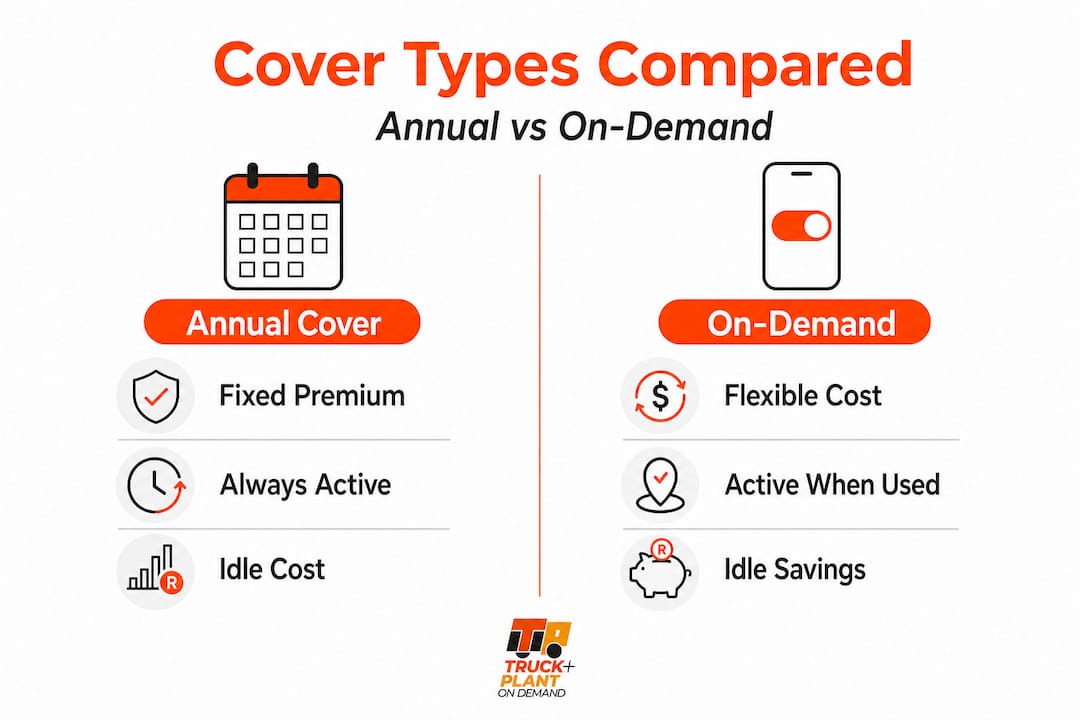
This approach is fundamentally different from annual cover. Traditional policies run continuously whether your fleet is active or parked. On-demand cover is dynamic. It responds to your operational calendar.
Here is how the two models compare:
| Feature | Traditional annual cover | On-demand cover |
|---|---|---|
| Premium structure | Fixed monthly or annual | Activated when needed |
| Flexibility | Low | High |
| Suited to | Constant, predictable use | Project-based, seasonal use |
| Cash flow impact | Fixed outflow | Variable, matches income |
| Risk of gaps | High if lapsed | Managed by operator |
| Administrative control | Minimal | Full operator control |
For a construction company running a seasonal road-building contract, on-demand cover means you activate full protection when the machines roll out and scale back when they return to the yard. For a transport operator taking on a three-month logistics contract, you cover the specific trucks involved for exactly that period.
Practical activation scenarios include:
- Project-based contractors who mobilise equipment for a two to four month contract and then demobilise
- Rental operators who need cover only when a machine is on hire
- Seasonal operators such as those working on agricultural infrastructure who have clear peak and off-peak cycles
- Multi-asset fleet owners who rotate equipment across different job sites
The importance of on-demand insurance becomes especially clear when you factor in how South African construction contracts are structured, often with tight margins and unpredictable timelines.
Pro Tip: If your machinery is financed, timing your insurance activation is critical. Banks and asset financiers need confirmed cover before releasing payouts, so activating your policy before submitting finance paperwork avoids delays and potential lender disputes.
Cost and cash flow advantages: On-demand vs traditional cover
Let us make the cost conversation practical. Imagine you own four pieces of yellow plant equipment: a TLB, a tipper truck, an excavator, and a compactor. Under a traditional annual policy, all four are covered continuously. But realistically, your contracts mean that at any given time, two of those machines may be idle for six to eight weeks.
To estimate your potential savings, follow these steps:
- List all insured assets and note their individual monthly premium contributions
- Track idle periods for each machine over the past 12 months
- Calculate the premiums paid during idle months for each asset
- Compare that figure against what you would have paid under an on-demand model for only active months
- Factor in your project pipeline for the next 12 months to project forward savings
For many South African operators, this exercise reveals that 20 to 35 percent of their annual machinery insurance spend covers equipment that was not generating income at the time.
Compare annual vs on-demand insurance models carefully, because the right choice depends on your specific operational pattern. Businesses with unpredictable contract cycles benefit most from the flexibility, while those with consistent year-round use may find a hybrid approach more practical.
| Cost factor | Traditional cover | On-demand cover |
|---|---|---|
| Idle asset cost | Full premium applies | No premium during idle periods |
| Budget predictability | High (fixed premiums) | Moderate (varies with use) |
| Savings potential | Low | High for seasonal operators |
| Finance compliance | Continuous cover easy to prove | Requires careful timing |
| Admin burden | Minimal | Slightly higher (activation management) |
Properly scheduled cover is important for cash flow and funding continuity, which is why on-demand models work best when you plan activations around your contract calendar rather than reacting to events.
Setting up on-demand insurance correctly from the start is essential to realising these savings without creating compliance gaps. And the on-demand benefits for South African businesses extend beyond cost reduction to include better cash flow management during the lean months between contracts.
How on-demand insurance safeguards your operations
Reducing premiums is one benefit. Managing operational risk is another, and it is equally important. On-demand cover, used correctly, actually improves your risk profile rather than increasing exposure.
When you transition between contracts, there is a brief but genuinely risky period. Equipment is being transported, operators are unfamiliar with new site conditions, and administrative oversight is often stretched. Having clear, active cover during these transitions protects you precisely when you are most vulnerable.
Here is where on-demand cover strengthens your risk management:
- Contract compliance: Many South African project owners and government clients require current proof of insurance before equipment is allowed on site. On-demand cover lets you provide this promptly and accurately.
- Audit readiness: Lenders and auditors can request cover documentation at any time. When you actively manage your activations, your records are clean and timestamped.
- Transitional risk management: Activating cover before mobilisation means there is no gap between when machines leave the yard and when they arrive on site.
- Third-party liability: Active cover ensures that any damage to third-party property or infrastructure during a job is not your personal financial burden.
Managing risk in the civil and construction industries requires a structured approach, and your insurance strategy is one of the most controllable elements of that.
Pro Tip: Keep a simple digital log of every cover activation and suspension, including dates and the specific machines covered. This takes minutes to maintain and can save hours when responding to lender or auditor queries. Many fulfillment and logistics requirements in contract-based industries also require documented insurance records as part of compliance submissions.
If you work with rented or hired equipment, rental machinery cover tips are worth reviewing, as the responsibilities and timing requirements differ from owned assets.
Practical steps to implement on-demand cover
Getting started with on-demand machinery insurance is straightforward. The key is to approach it with the same level of planning you apply to your project schedules.
- Audit your current assets: List every machine and vehicle you own or operate, along with their current insurance status and the lender details if financed.
- Identify your operational calendar: Map out when each asset is likely to be in use over the next 6 to 12 months based on confirmed and expected contracts.
- Set up your on-demand policy: Work with a provider that understands the construction and transport sectors. Choose cover types that match your asset categories, including third-party liability, comprehensive, and tools of trade where relevant.
- Align activations with your project start dates: Do not wait until the day a machine mobilises. Activate cover at least 48 hours in advance to ensure finance and contract compliance.
- Confirm lender requirements before activating: Asset financiers need confirmed comprehensive cover before releasing payouts, so always check that your activation timing satisfies these conditions.
- Communicate with your project manager or site supervisor: Make sure the person managing boots on the ground knows when cover is active and can confirm this to site administrators if required.
- Review your activations monthly: At the end of each month, compare your activation schedule against your actual site activity. Adjust your forward planning accordingly.
Common pitfalls to avoid include activating cover after a machine has already left the yard, failing to notify your lender of cover periods for financed equipment, and assuming that suspended cover automatically reinstates when you start a new project. Setting up cover for your fleet requires deliberate planning, not reactive management.
The hidden edge: What most businesses miss about on-demand insurance
Most business owners approach on-demand insurance as a cost-cutting tool. Activate when busy, pause when not. Simple. But that framing misses the real strategic value.
The businesses that benefit most from on-demand cover are not the ones who are quickest to switch off. They are the ones who are most deliberate about switching on. There is a critical difference. Reactive management of your cover means you are always responding to what has already happened. Proactive schedule management means your insurance calendar is planned three to six months ahead, aligned with your project pipeline, and reviewed regularly.
Here is the insight that most operators miss: the true saving is not just in the months you do not pay premiums. It is in the months where you pay exactly the right premium for exactly the right assets. That precision is what smart insurance trends in the industry are moving toward, and operators who build this discipline now will have a structural advantage over those who are still managing insurance reactively.
Another overlooked area is pre-funding activation. When you finance new equipment, there is a window between loan approval and payout where cover must already be confirmed. Many operators lose days or even weeks of project time because they did not anticipate this requirement. Building a “pre-activation checklist” into your procurement process eliminates this friction entirely.
Looking ahead, integrated platforms are beginning to automate cover activation based on equipment telemetry and project data. Businesses that have already adopted the discipline of active cover management will adapt to these platforms quickly. Those who have been passive will find themselves under-prepared for that shift.
Get flexible machinery insurance to match your business
You now understand the real cost of inflexible cover and the practical value of managing your insurance proactively. The next step is putting the right platform in place.
Truck & Plant On-Demand™ was built specifically for South African construction and transport operators who are tired of paying for cover they do not need. Whether you manage a single truck or a diverse fleet of yellow plant equipment, our platform gives you full control. You choose what to cover, when to activate it, and how to structure your protection as your operations change. Explore our fleet insurance for commercial vehicles or get a tailored quote for truck insurance in South Africa. If you need protection for attachments and accessories, our tool of trade insurance has you covered. Get in touch today and start paying only for what you actually use.
Frequently asked questions
Is on-demand machinery insurance accepted by banks and financiers?
Yes, on-demand cover is accepted provided the policy meets the lender’s requirements for comprehensive cover with noted financial interest. Comprehensive cover with noted financial interest is generally required before finance payout, so timing your activation correctly is essential.
Can on-demand insurance really save my business money?
It can deliver meaningful savings for any operator with idle periods between contracts, as you only pay for the cover you need. Properly scheduled cover also supports better cash flow management, especially during quieter months.
What happens if I activate cover too late for a financed machine?
Late activation can delay finance payouts and may breach your lender agreement. Confirmed cover is usually needed before finance payout proceeds, so always build lead time into your activation schedule.
Is on-demand insurance suitable for short-term rentals or contract-based work?
It is particularly well suited to this type of work because you can match cover precisely to the period of use. On-demand activation must be timed to satisfy lender and contractual conditions, but for rental and contract operators, the flexibility is a significant operational advantage.